India’s early wind farms are aging fast. Many turbines installed between 2000 and 2012 are still spinning, but the brains behind them, the SCADA and control systems, are not keeping up. Legacy software crashes. Spare parts for old PLCs are hard to find. Operators lose visibility into real-time turbine health, and that costs money.
Full turbine replacement is one option, but it’s expensive and often unnecessary. The mechanical and electrical core of a turbine can run reliably for decades if it’s maintained well. The real bottleneck is usually the “nervous system”, the monitoring, control, and data layer sitting on top of it.
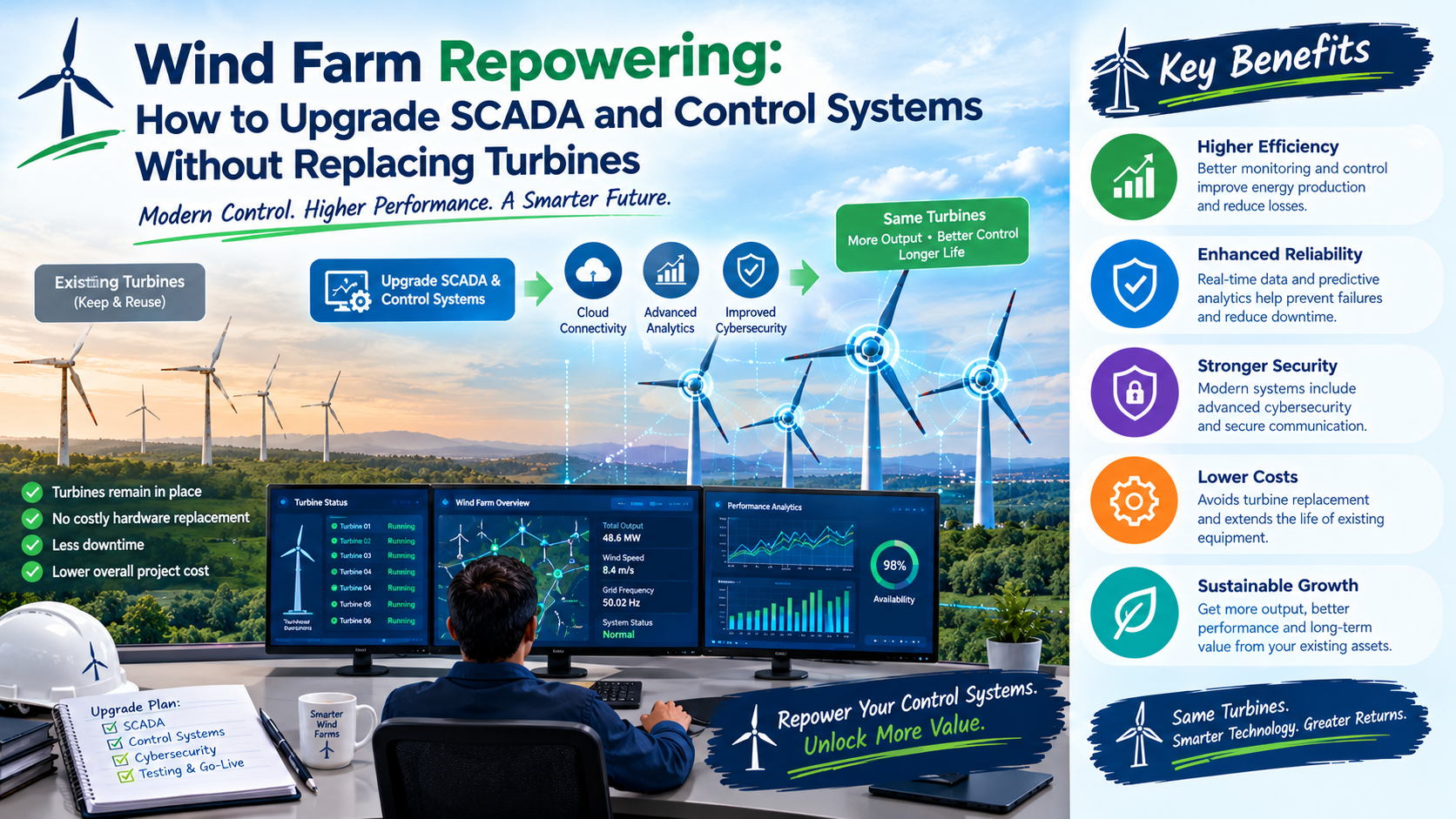
This is where wind farm repowering through SCADA and control system modernization comes in. Instead of swapping out an entire turbine, owners and operators can upgrade the control architecture, extend asset life, and unlock performance gains, at a fraction of the cost of full repowering.
In this guide, we’ll break down what wind farm repowering really means, why legacy SCADA systems are a hidden liability, and how a phased upgrade path can protect your investment while improving output. If you manage aging wind assets in India or operate O&M for a wind portfolio, this is written for you.
What Is Wind Farm Repowering?
Wind farm repowering is the process of upgrading an existing wind farm’s technology, turbines, components, or control systems, to improve performance, reliability, and lifespan, instead of decommissioning the site entirely.
There are generally three approaches:
- Full repowering — replacing old turbines with new, higher-capacity machines.
- Partial repowering — replacing major components like gearboxes, blades, or generators while keeping the tower and foundation.
- Technology/control repowering — upgrading SCADA, PLCs, sensors, and communication systems without touching the turbine’s mechanical core.
Technology-led wind farm repowering solutions are increasingly the preferred route for assets that are mechanically sound but digitally outdated. It’s faster to deploy, carries lower capital risk, and often delivers a quicker return on investment than full mechanical repowering.
Why SCADA Is the Weak Link in Aging Wind Farms
A wind turbine’s SCADA system is its command center. It collects data from sensors, controls pitch and yaw, manages safety shutdowns, and reports performance back to the operator. When this layer ages, the whole farm suffers, even if the turbine blades are in perfect shape.
Common Problems with Legacy SCADA Systems
- Obsolete hardware — original equipment manufacturers (OEMs) stop supporting old controllers, making repairs slow and expensive.
- Poor data visibility — operators can’t see real-time performance trends, so faults go unnoticed until they become failures.
- Limited remote access — older systems often require a technician on-site just to pull basic diagnostics.
- Cybersecurity gaps — legacy systems weren’t built with today’s OT security threats in mind.
- Incompatible protocols — old SCADA can’t talk to modern asset management or analytics platforms.
Industry data consistently shows that unplanned downtime from control and electrical system failures, not blade or gearbox failures, accounts for a significant share of lost generation hours in older wind fleets. In other words, the fastest way to lose revenue on an aging wind farm isn’t a mechanical failure. It’s a control system that can’t warn you in time.
Why Upgrade Instead of Replace?
Full turbine replacement makes sense for very old, low-capacity machines nearing the end of their structural life. But for many mid-life assets, typically 10 to 20 years old, the tower, foundation, and drivetrain still have years of productive life left.
Benefits of SCADA and Control System Upgrades Over Full Turbine Replacement
- Lower capital cost — a fraction of the price of new turbines and civil works.
- Faster deployment — control upgrades can often be completed in weeks, not months.
- Minimal site disruption — no crane mobilization, no foundation work, no grid connection re-approval in most cases.
- Immediate performance gains — better data, better control logic, fewer unplanned trips.
- Extended asset life — modern monitoring supports predictive maintenance, which reduces wear-driven failures.
This is the core logic behind wind turbine life extension strategies: don’t throw away a mechanically sound asset because its digital layer is outdated. Fix the layer that’s actually failing.
What a Modern SCADA and Control System Upgrade Includes
A well-planned wind farm SCADA upgrade isn’t just a software patch. It typically touches several layers of the turbine and farm architecture.
1. PLC and Controller Modernization
Old programmable logic controllers (PLCs) are often the first thing to fail or go out of support. Wind turbine PLC upgrades replace outdated controllers with modern, industrial-grade hardware that’s compatible with current safety standards and communication protocols, without altering the turbine’s mechanical setup.
2. SCADA Software and HMI Modernization
Replacing legacy human-machine interfaces (HMI) and SCADA software gives operators a modern dashboard with real-time visualization, historical trending, and alarm management. This is central to any SCADA modernization for wind farms projects.
3. Sensor and Condition Monitoring Upgrades
Adding or upgrading vibration sensors, temperature probes, and oil condition sensors enables wind turbine condition monitoring, catching early signs of bearing wear, gearbox stress, or generator issues before they cause a breakdown.
4. Communication and Data Acquisition Systems
Modern wind farm data acquisition systems use robust, standardized protocols (like IEC 61400-25 or Modbus TCP) so turbine data can flow cleanly into central SCADA, historian databases, and third-party analytics tools.
5. Remote Monitoring and Cloud Connectivity
Wind farm remote monitoring allows O&M teams to track turbine health from a central control room, or even a mobile device, cutting down on unnecessary site visits and speeding up fault response.
6. Cybersecurity Hardening
As wind farms digitize, they become more exposed to cyber threats. A proper upgrade includes network segmentation, secure remote access, and updated firmware, closing gaps that legacy systems left wide open.
How Wind Farm SCADA Upgrades Improve Performance
A modernized SCADA and control layer doesn’t just reduce risk, it actively improves how much energy a wind farm produces and how efficiently it’s run.
Key performance benefits include:
- Reduced downtime through early fault detection and predictive alerts
- Higher availability via faster diagnostics and remote troubleshooting
- Better yaw and pitch optimization, improving energy capture
- Lower O&M costs from fewer emergency site visits and truck rolls
- Improved reporting accuracy for regulatory and investor requirements
This combination of better uptime and better data is what drives real wind farm performance optimization, the actual goal behind most repowering decisions, not just a technology refresh for its own sake.
How to Plan a SCADA and Control System Upgrade: A Step-by-Step Approach
Jumping straight into hardware replacement without a plan is a common and costly mistake. Here’s a practical, phased approach to wind turbine control system modernization.
Step 1: Conduct a Technical Audit
Assess the current state of SCADA, PLCs, sensors, and communication infrastructure across the farm. Identify which components are obsolete, which are at end-of-life, and which can be retained.
Step 2: Define Upgrade Priorities
Not every turbine needs every upgrade at once. Prioritize based on failure history, criticality, and remaining useful life of existing components.
Step 3: Design the New Control Architecture
Plan the integration between new PLCs, SCADA software, sensors, and existing turbine systems, ensuring backward compatibility where needed and forward compatibility with future analytics platforms.
Step 4: Pilot on a Small Cluster
Before a full fleet rollout, test the upgraded system on a handful of turbines. This limits risk and validates performance improvements with real data.
Step 5: Full-Scale Rollout
Once validated, roll out the upgrade across the remaining turbines in planned maintenance windows to minimize generation loss.
Step 6: Continuous Monitoring and Optimization
Post-upgrade, use the new data visibility to fine-tune control parameters, maintenance schedules, and performance benchmarks over time.
This structured path is core to effective wind farm automation systems deployment, reducing project risk while maximizing the return on every rupee spent on the upgrade.
Wind Farm Digitalization: The Bigger Picture
SCADA upgrades are often the entry point into a broader wind farm digitalization journey. Once modern data infrastructure is in place, operators can layer in:
- Predictive maintenance models that flag component wear before failure
- Digital twins for performance simulation and what-if analysis
- Fleet-wide benchmarking across multiple sites
- Integration with power plant controllers (PPC) for grid compliance and reactive power management
For operators managing multiple wind assets, this shift from reactive to wind farm predictive maintenance is where the long-term cost savings really show up.
Why This Matters for Wind Farm Owners and Operators in India
India’s installed wind capacity includes a large base of turbines approaching or past the mid-point of their design life. For asset owners, EPC companies, and O&M providers managing these fleets, the choice isn’t really “repower or retire.” It’s “upgrade intelligently or keep absorbing avoidable losses.”
Wind turbine retrofit solutions focused on control systems let owners:
- Protect existing capital investment in towers, foundations, and drivetrains
- Improve PPA compliance through better reporting and grid interaction
- Reduce the operational burden on thin O&M teams
- Extend the commercially viable life of the asset by several years
This is particularly relevant in the current Indian renewable energy landscape, where grid codes, RE purchase obligations, and performance guarantees are becoming stricter, and operators need reliable, real-time data to stay compliant.
Why GEISPL for Wind Farm Repowering and SCADA Modernization
GEISPL, based in Bangalore, has over a decade of hands-on experience designing and deploying SCADA, control panels, and substation automation systems for renewable energy assets across India. GEISPL’s portfolio includes work with major OEMs and power generation companies, and spans SCADA, Compact SCADA, Power Plant Controllers, Micro SCADA, and PLC/DAQ panel solutions purpose-built for wind and hybrid energy sites.
This matters for a repowering project because upgrading wind turbine control systems isn’t a plug-and-play task, it requires deep familiarity with turbine OEM protocols, grid codes, and the practical realities of retrofitting live, operational assets without extended downtime. GEISPL’s engineering team has done exactly this across 60+ installations, working directly with wind farm owners, EPC companies, and O&M teams to modernize aging assets while keeping generation losses to a minimum.
Explore GEISPL’s SCADA solutions and Power Plant Controller offerings, or see how similar upgrades have performed in the field through GEISPL’s wind energy case studies and Wind Energy Solutions page.
FAQs on Wind Farm Repowering and SCADA Upgrades
1. What is wind farm repowering?
Wind farm repowering is the process of upgrading an existing wind farm’s turbines, components, or control systems to improve performance and extend operational life, instead of fully decommissioning the site.
2. Can SCADA systems be upgraded without replacing the entire turbine?
Yes. SCADA and control system upgrades, including PLC modernization, new HMI software, and improved sensors, can be installed on existing turbines without touching the mechanical drivetrain, tower, or foundation.
3. How long does a wind turbine SCADA upgrade take?
Timelines vary by fleet size, but a pilot cluster upgrade can often be completed in a few weeks, with full fleet rollout phased over planned maintenance windows to limit generation downtime.
4. What are the benefits of wind farm SCADA modernization?
Benefits include reduced unplanned downtime, better fault detection, improved remote monitoring, stronger cybersecurity, and more accurate performance reporting, all of which support higher energy output and lower O&M costs.
5. Is control system upgrading cheaper than full turbine replacement?
Generally, yes. Technology and control-layer upgrades cost significantly less than full turbine replacement since they avoid new equipment procurement, crane mobilization, and civil works.
6. How do I know if my wind farm needs a SCADA upgrade?
Signs include frequent unplanned outages, lack of real-time visibility into turbine health, obsolete or unsupported PLC hardware, and difficulty integrating with modern analytics or reporting tools.
Conclusion: Repower Smarter, Not Harder
Wind farm repowering doesn’t always mean new turbines. For many aging wind assets, the real value lies in upgrading what sits between the turbine and the operator, the SCADA, PLC, and control layer. A well-planned wind farm SCADA upgrade restores visibility, reduces downtime, and extends the productive life of assets that are otherwise mechanically sound.
If your wind farm’s control systems are aging faster than your turbines, it’s time for an expert assessment, not a full replacement.
Talk to GEISPL’s engineering team about a SCADA and control system upgrade plan for your wind assets.
Office: 080-4160-1403
Contact: reachus@geispl.in
D38, 4th A Main Road, Rajajinagar Industrial Estate, Bangalore - 560010 | Open Maps
Category: SCADA