
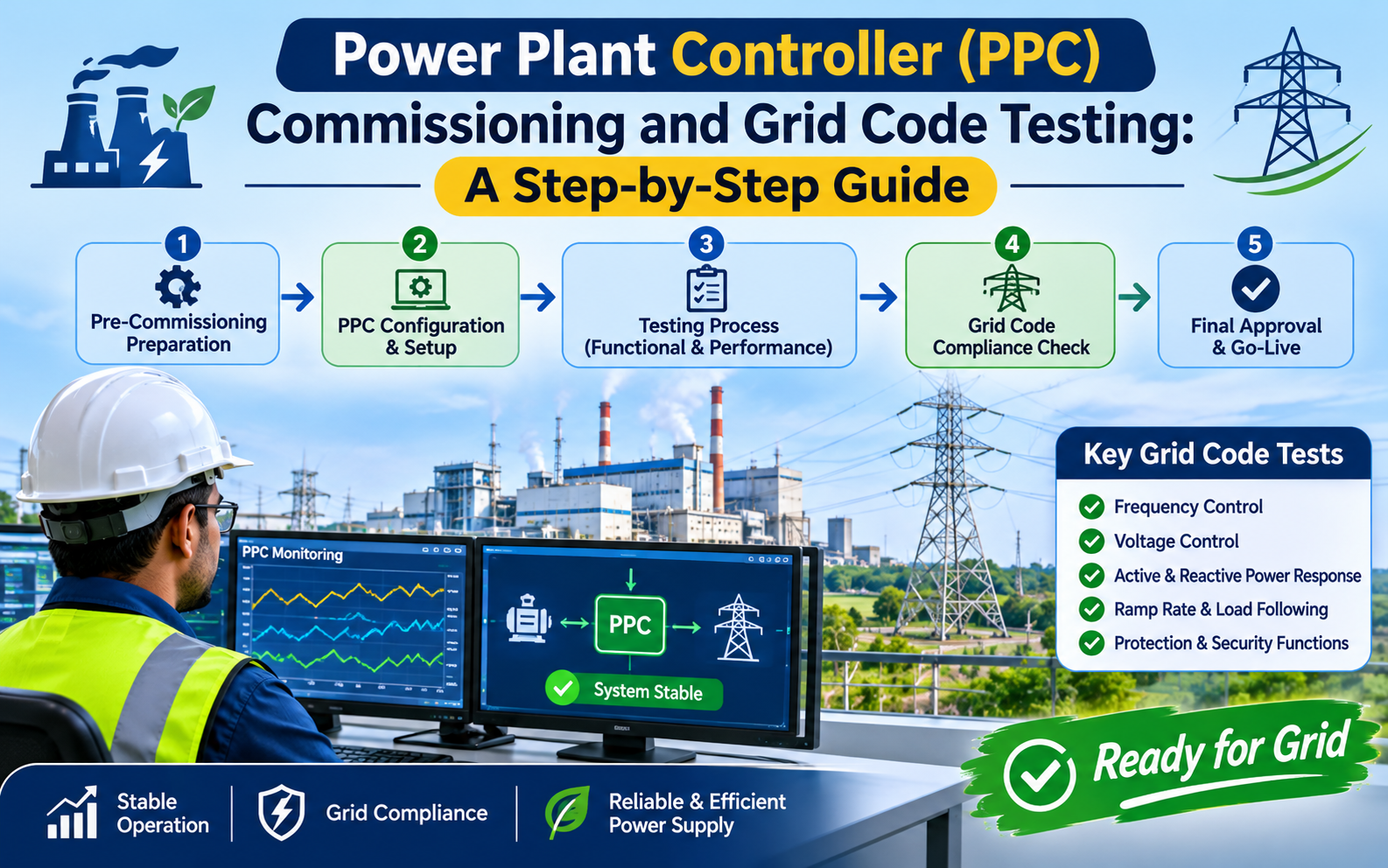
Learn the full Power Plant Controller commissioning process and grid code testing steps for solar and wind plants. Expert PPC guide by GEISPL, Bangalore.
Introduction
A renewable energy plant can have the best turbines or the most efficient solar panels in the country, and still fail to connect to the grid. Why? Because grid operators don’t just check how much power a plant can produce. They check how well the plant behaves on the grid. This is where Power Plant Controller Commissioning becomes the make-or-break step in any solar or wind project.
Power Plant Controller (PPC) commissioning is the structured process of installing, configuring, and testing a plant-level control system so it can manage active power, reactive power, voltage, and frequency according to grid code requirements. Without proper PPC commissioning and grid code testing, even a technically sound power plant can be denied grid connectivity, delayed by months, or penalized financially.
In this guide, we’ll walk through the complete PPC commissioning process step by step, from pre-commissioning checks to final grid code compliance testing, so EPC companies, plant owners, and O&M teams know exactly what to expect and how to prepare.
What Is a Power Plant Controller (PPC)?
A Power Plant Controller (PPC) is a centralized control system installed at a solar, wind, or hybrid power plant. It sits between the individual inverters or turbines and the grid connection point, and it acts as the plant’s “brain” for grid interaction.
In simple terms, a PPC:
- Collects real-time data from inverters, turbines, meters, and substation equipment
- Compares plant output against grid operator setpoints
- Adjusts active power, reactive power, voltage, and power factor automatically
- Communicates with the grid operator’s SCADA system (often via IEC 60870-5-104 or IEC 61850 protocols)
Put simply, the PPC ensures the entire plant behaves as one coordinated unit, not as hundreds of individual inverters acting independently.
Why Power Plant Controller Commissioning Matters
Grid codes exist because renewable energy now makes up a large share of total generation capacity. According to global industry data, renewable sources accounted for the majority of new power capacity additions worldwide in recent years, and grid operators have tightened compliance requirements as a result. A single non-compliant plant can destabilize local grid frequency or voltage, so regulators now require formal PPC commissioning and grid code testing before granting connection approval.
For plant owners, this translates into three real business risks if commissioning is rushed or skipped:
- Delayed Commercial Operation Date (COD) — Grid approval can be withheld until tests pass
- Revenue loss — Every month of delay is a month of lost generation revenue
- Penalties — Some grid codes impose financial penalties for non-compliant operation after connection
This is why PPC commissioning should be planned as early as the design stage, not treated as a last-minute formality before synchronization.
Power Plant Controller Commissioning: Step-by-Step Process
Here is the complete power plant commissioning process, broken into the stages most commonly followed across solar and wind projects in India and globally.
Step 1: Pre-Commissioning Document and Design Review
Before any physical testing begins, the commissioning team reviews:
- Grid connection agreement and applicable grid code (CEA, state DISCOM, or international standard)
- Single-line diagrams and control philosophy documents
- PPC hardware and software configuration
- Communication architecture between PPC, SCADA, and the grid operator
A thorough design review at this stage prevents expensive rework later, especially for solar power plant controller and wind power plant controller setups with multiple inverter vendors.
Step 2: Hardware Installation and Panel Checks
The PPC panel is installed, wired, and inspected for:
- Correct CT/PT (current transformer/potential transformer) connections
- Power supply redundancy
- Earthing and surge protection
- Physical labeling matching the approved drawings
Step 3: SCADA Integration Testing
SCADA integration testing confirms that the PPC can correctly send and receive data from the plant’s SCADA system. This includes:
- Mapping all signal points (active power, reactive power, voltage, frequency, alarms)
- Verifying data refresh rates meet grid operator requirements
- Confirming historical data logging works correctly
Step 4: PPC Communication Testing
PPC communication testing validates the link between the PPC and the grid operator’s control center or load dispatch center. Engineers verify:
- Protocol compliance (IEC 60870-5-104, IEC 61850, Modbus, or DNP3 as specified)
- Command-and-response latency
- Failover behavior if communication is lost
- Setpoint reception accuracy
Step 5: Functional Testing of Control Loops
This is the technical core of PPC functional testing, covering four key control functions:
Active Power Control Testing
Confirms the PPC can ramp plant output up or down smoothly in response to grid operator commands, including curtailment and ramp-rate limits.
Reactive Power Control Testing
Verifies the plant can absorb or inject reactive power within the required range to support grid voltage.
Voltage Control Testing
Checks the plant’s ability to regulate voltage at the point of common coupling (PCC) within grid code tolerances.
Frequency Control Testing
Confirms the PPC responds correctly to frequency deviations, a critical requirement as grids integrate more variable renewable generation.
Power Factor Control Testing
Validates the plant maintains the target power factor across different loading conditions.
Step 6: Grid Synchronization Testing
Grid synchronization testing checks that the plant connects to the grid smoothly, matching voltage, frequency, and phase angle,without causing transients or disturbances at the point of interconnection.
Step 7: Grid Code Compliance Testing
This is the formal stage where the plant demonstrates full grid code compliance testing results to the regulator or transmission utility. It typically includes:
- Low Voltage Ride Through (LVRT) / Fault Ride Through (FRT) simulation
- Reactive power capability curve verification
- Frequency response under simulated grid events
- Documentation submission for regulatory sign-off
Step 8: Plant-Level Power Control Verification
Here, the entire plant, not just individual inverters, is tested as one unit to confirm coordinated plant-level power control across all control objectives simultaneously.
Step 9: Power Plant Acceptance Testing
The final stage is power plant acceptance testing, where the utility or an independent third party validates that all previous test results meet grid code thresholds before issuing formal connection approval.
Power Plant Controller Commissioning Checklist
Use this quick-reference checklist before scheduling grid code tests:
- Design documents and single-line diagrams approved
- PPC hardware installed and inspected
- SCADA integration testing completed
- PPC communication testing passed with grid operator systems
- Active, reactive, voltage, frequency, and power factor control tested
- Grid synchronization testing completed without faults
- LVRT/FRT simulation results documented
- All test reports compiled for regulatory submission
- Acceptance testing scheduled with the utility or DISCOM
Solar vs. Wind PPC Commissioning: Key Differences
While the core process is similar, there are practical differences worth noting:
- Solar power plant controller commissioning often deals with a larger number of smaller inverters, requiring more extensive signal mapping during SCADA integration.
- Wind power plant controller commissioning typically involves fewer, larger turbine units but more complex reactive power coordination due to turbine type (Type 3 or Type 4).
- Hybrid plants (solar + wind + storage) require additional coordination logic so the PPC manages multiple generation sources without conflicting commands, a growing requirement as more hybrid projects come online in India.
Common Challenges in PPC Commissioning (and How to Avoid Them)
Based on field experience across multiple renewable energy grid integration projects, the most frequent causes of delay are:
- Incomplete signal mapping between inverters and the PPC, discovered only during SCADA integration testing
- Communication protocol mismatches between PPC and the grid operator’s system
- Underestimating LVRT/FRT simulation time, which often requires specialized test equipment
- Late involvement of the commissioning team, leading to design issues found too late to fix cheaply
The fix for most of these is simple: involve experienced PPC testing engineers during the design phase, not just before synchronization.
Why GEISPL for PPC Commissioning and Grid Code Testing
GEISPL, based in Bangalore, designs, builds, and commissions Power Plant Controllers (PPC) for solar, wind, and hybrid plants across India. This matters for anyone evaluating a commissioning partner because the company works across the full chain, not just the PPC panel, but the surrounding SCADA and Micro SCADA systems, relay panels, and substation automation that the PPC must communicate with. That end-to-end view reduces the integration gaps that typically cause commissioning delays.
GEISPL’s PPC solutions are built for:
- Wind energy plants requiring robust reactive power coordination
- Solar energy plants needing precise multi-inverter control
- Hybrid solar-wind-storage configurations
The company is trusted by major OEMs and power generation companies, holds ISO 9001 and ISO 27001 certifications, and has supported substation design and grid integration work documented in case studies such as the Transcend Design Generator for wind substation design. GEISPL also provides ongoing O&M and asset management support after commissioning, so plants remain compliant as grid codes evolve.
If you’re planning a PPC commissioning project, GEISPL’s team can review your design, run functional and grid code compliance tests, and support the full acceptance process from pre-commissioning checks through utility sign-off.
Talk to GEISPL’s PPC Experts →
Frequently Asked Questions
1. What is Power Plant Controller (PPC) commissioning?
PPC commissioning is the process of installing, configuring, and testing a power plant’s control system so it can regulate active power, reactive power, voltage, and frequency according to the grid operator’s grid code requirements before the plant is approved for connection.
2. How long does PPC commissioning typically take?
Timelines vary by plant size and grid code complexity, but most solar and wind PPC commissioning projects take several weeks, covering SCADA integration, functional testing, and grid code compliance testing before final acceptance.
3. What is grid code testing for power plants?
Grid code testing verifies that a power plant’s control system meets the technical requirements set by the grid operator, including voltage ride-through, frequency response, reactive power capability, and communication protocol compliance.
4. What is the difference between PPC functional testing and grid code compliance testing?
PPC functional testing checks that individual control loops (active power, reactive power, voltage, frequency) work correctly. Grid code compliance testing is the formal validation stage that confirms the plant meets the specific thresholds set by the regulator or utility.
5. Why is SCADA integration important in PPC commissioning?
SCADA integration ensures the PPC can send accurate, real-time data to the plant operator and grid control center. Without reliable SCADA integration testing, the PPC cannot respond correctly to grid operator setpoints.
6. Do solar and wind plants need different PPC commissioning approaches?
The core commissioning steps are the same, but solar plants usually involve more inverters requiring detailed signal mapping, while wind plants often need more complex reactive power coordination depending on turbine type.
Conclusion
Power Plant Controller commissioning is not just a technical formality, it’s the step that determines whether a renewable energy plant can legally and reliably connect to the grid. From SCADA integration testing and PPC communication testing to active power, reactive power, voltage, and frequency control testing, each stage plays a role in achieving full grid code compliance testing approval.
Plants that treat PPC commissioning as a planned, early-stage activity, rather than a last-minute checkbox, consistently avoid the delays, penalties, and rework that plague rushed projects.
If you’re preparing for PPC commissioning or grid code testing on a solar, wind, or hybrid plant, GEISPL’s engineering team in Bangalore can support you from design review through final acceptance testing.
Office: 080-4160-1403
Email: reachus@geispl.in
D38, 4th A Main Road, Rajajinagar Industrial Estate, Bangalore – 560010 | Open in Maps
Category: SCADA