Every year, India adds thousands of megawatts of new wind capacity, and every new turbine that crosses into controlled airspace becomes a potential hazard to low-flying aircraft unless it’s properly marked. Aviation warning lights on wind turbines are not an optional safety add-on; they are a legal requirement under Indian civil aviation law, enforced by the Airports Authority of India (AAI), the Directorate General of Civil Aviation (DGCA), and the Ministry of New and Renewable Energy (MNRE).
For wind farm owners, EPC contractors, and O&M teams, getting this wrong isn’t a minor paperwork lapse. Non-compliant or non-functional obstruction lights have already triggered government intervention in India, including a 2020 directive threatening grid disconnection for wind farms near an Indian Air Force station. This guide breaks down exactly what the law requires, which standards apply, and how to stay compliant without disrupting operations.
Why Aviation Obstruction Lighting Matters for Wind Farms
A modern wind turbine nacelle can sit 120–180 meters above ground level, with rotor tips reaching even higher. At that height, a turbine becomes a genuine collision risk for military aircraft, medical evacuation helicopters, agricultural aircraft, and low-altitude civil flights, especially at night or in poor visibility.
This is exactly why wind turbine aviation lights compliance in India sits at the intersection of two regulatory worlds: renewable energy development and civil aviation safety. A wind farm can be fully compliant with MNRE’s energy regulations and still be in violation of aviation law if its obstruction lighting is missing, incorrectly specified, or simply switched off.
Real-world example: In January 2020, MNRE issued a formal directive after the Indian Air Force reported that obstacle lights on several wind turbines near Bhuj Air Force Station were damaged or non-functional. The ministry warned operators that continued non-compliance could result in disconnection from the grid. This single incident illustrates how aviation lighting compliance directly affects revenue-generating assets, not just paperwork.
What Is Aviation Obstruction Lighting on a Wind Turbine?
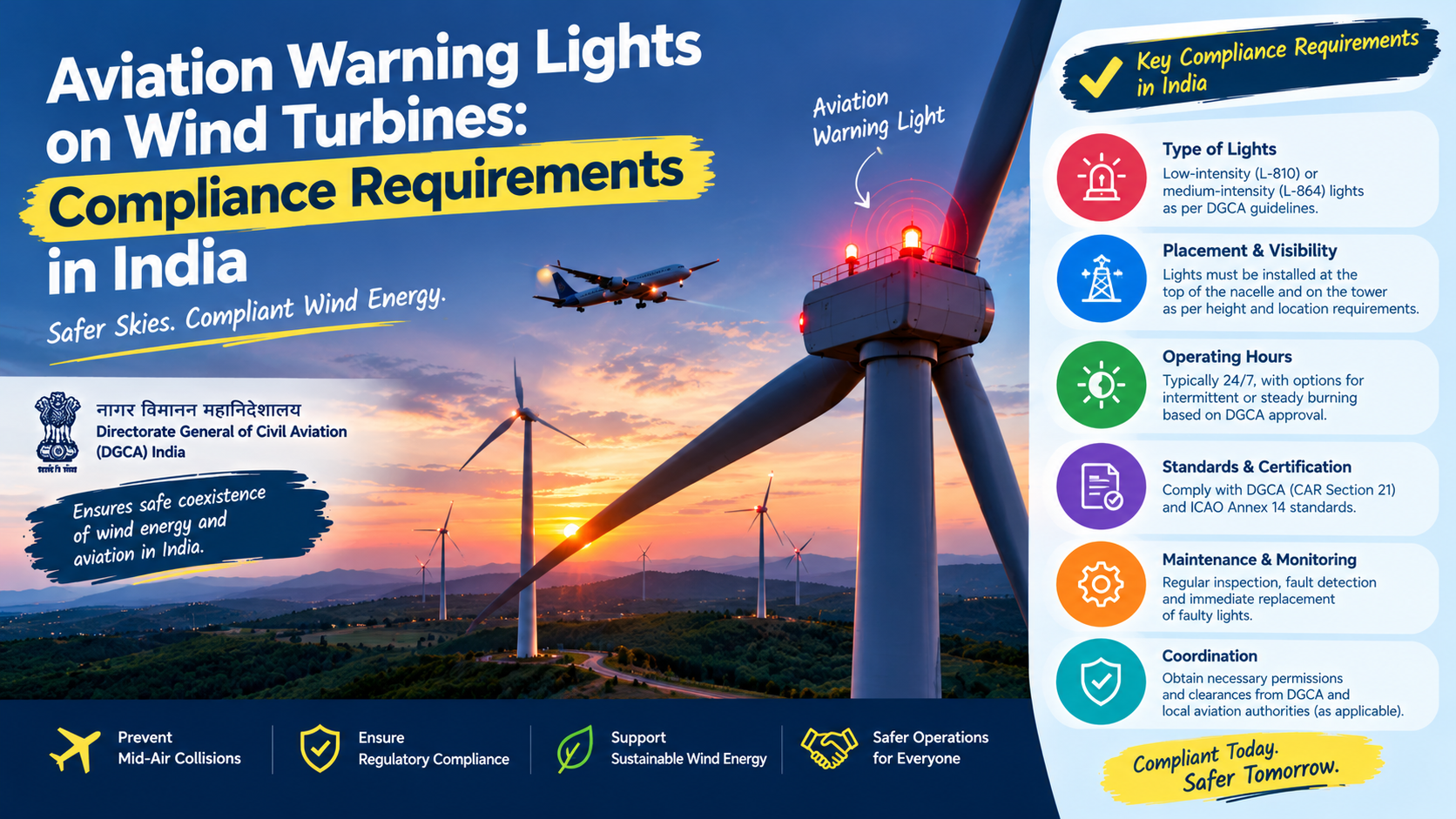
Aviation warning lights for wind turbines are standardized visual markers, typically red or white LED beacons, mounted on the nacelle (and sometimes the tower) to alert pilots to the turbine’s location, height, and presence within a wind farm cluster.
These lights fall into three broad categories recognized under ICAO and Indian standards:
- Low-intensity lights — Steady or flashing red lights used on shorter structures or in combination with medium-intensity systems.
- Medium-intensity aviation obstruction lights — The most common choice for wind turbines, available as white flashing (daytime) or red flashing (night) beacons.
- High-intensity aviation warning lights — Used on very tall structures or in high-risk flight corridors, typically white flashing and visible from significant distances.
Most Indian wind turbine nacelle warning light installations use medium-intensity dual-mode systems: white flashing during the day and automatically switching to red at dusk, based on ambient light sensors.
Regulatory Framework: Who Governs Wind Turbine Lighting in India?
Unlike many compliance requirements that sit under a single authority, civil aviation regulations for wind turbines India involve overlapping jurisdiction across several bodies.
1. Ministry of Civil Aviation (MoCA) and AAI
Height clearance and obstruction lighting for any structure, including wind turbine, is governed by MoCA’s notification GSR 751(E), dated 30 September 2015 (as amended by GSR 770(E), 2020), now read alongside the Bharatiya Vayuyan Adhiniyam, 2024. Any structure within the notified radius of an airport or aerodrome, commonly up to 56 km depending on the airport category, requires a No Objection Certificate (NOC) from AAI before construction.
2. AAI’s NOC Application System (NOCAS)
AAI processes height clearance applications through its online NOCAS portal (nocas2.aai.aero). The system calculates the Permissible Top Elevation (PTE) for a given site based on Above Mean Sea Level (AMSL) data, and the issued NOC specifies the maximum permissible structure height. NOCs are typically valid for 8 years, and operators must apply for renewal if construction isn’t completed within that window.
3. DGCA Guidelines
DGCA guidelines for wind turbine lighting are detailed in the Civil Aviation Requirements (CAR), Series B, Part I, Section 4, which prescribes marking and lighting specifications for obstructions that could affect aircraft operations.
4. Ministry of New and Renewable Energy (MNRE)
Wind developers operating near defence installations are often required, as a condition of their project NOC, to comply with IS 5613 notification and ICAO obstruction lighting requirements for wind turbines. MNRE has directly intervened when this condition was violated, as seen in the Bhuj case.
If you’re unsure which authority applies to your site, GEISPL’s asset management team can help map your compliance obligations before installation begins.
Indian and International Standards That Apply
Wind turbine lighting standards in India draw from both domestic and international frameworks:
- IS 5613 — The Indian Standard referenced in AAI/MNRE NOC conditions for obstruction marking and lighting.
- ICAO Annex 14 — The international baseline for obstruction lighting for tall structures in India, defining light intensity categories, flash characteristics, and placement rules.
- IEC/BIS 61400-29 (draft) — The Bureau of Indian Standards has been developing a dedicated standard, “Wind Energy Generation Systems – Part 29: Marking and Lighting of Wind Turbines,” aligned with the international IEC TS 61400-29 specification, reflecting the sector’s shift toward turbine-specific lighting rules rather than generic structure rules.
Key Lighting Rules for Wind Farms
- All obstruction lights on turbines within a single wind farm must flash simultaneously, unsynchronized flashing is treated as a non-conforming installation.
- LED aviation warning lights for wind turbines are now the industry default, replacing older xenon strobe systems, due to lower power draw, longer service life, and easier integration with SCADA-based monitoring.
- Lights must remain operational at all times, including during grid outages, which is why battery backup or solar-powered obstruction lights are increasingly specified for remote wind sites.
- Perimeter turbines in a cluster typically carry lighting, while interior turbines may be unlit depending on spacing, but any turbine exceeding a defined rotor-tip height threshold requires lighting regardless of its position in the layout.
Wind Turbine Aviation Lighting Compliance Checklist
Use this as a working reference for new installations or compliance audits:
- Confirm airport proximity — Check whether your site falls within AAI’s notified NOC zone (use NOCAS’s map feature).
- Apply for height clearance — Submit Form CA-1 with site coordinates (WGS84) and elevation certificates through NOCAS.
- Select the correct light category — Match intensity (low/medium/high) to turbine height and the aerodrome’s risk classification.
- Specify IS 5613 / ICAO-compliant fixtures — Confirm your OEM’s obstruction lights carry relevant type-testing documentation.
- Synchronize flash patterns across all lit turbines in the farm.
- Integrate lighting status into SCADA — Real-time fault alerts prevent the kind of “lights not working” violations that triggered MNRE’s 2020 directive.
- Schedule preventive maintenance — Periodic inspection of LED circuits, photocells, and backup power is essential for continuous compliance.
- Retain NOC and compliance records — Keep copies of your AAI NOC, light-type certification, and maintenance logs for audits.
GEISPL’s SCADA systems can monitor obstruction light status alongside turbine performance data, giving O&M teams a single dashboard for both energy output and aviation compliance.
Offshore and High-Rise Considerations
As India’s offshore wind pipeline develops, aviation lighting for offshore wind turbines introduces additional complexity, including marine navigation lighting overlap, higher-intensity requirements due to open-sea visibility conditions, and more demanding corrosion and reliability standards for the fixtures themselves. EPC companies planning offshore projects should factor aviation lighting into the design phase, not retrofit it post-installation.
How Non-Compliance Puts Wind Farm Operations at Risk
Beyond the obvious safety case, non-compliance carries direct business consequences:
- Grid disconnection risk — as explicitly warned by MNRE in its 2020 directive to wind developers.
- Delayed commissioning — projects cannot be commissioned without a valid AAI height clearance NOC.
- Operational liability — in the event of an aviation incident, non-functional or missing obstruction lights expose operators to regulatory and legal action.
- Reputational risk — for EPC and O&M companies, repeated compliance failures affect eligibility for future government and OEM contracts.
This is precisely why wind farm aviation safety requirements should be built into project planning from day one, not treated as a post-commissioning formality.
Why This Matters, and Why GEISPL
GEISPL has over a decade of hands-on experience integrating SCADA, control panels, and monitoring systems across wind and hybrid renewable energy sites in India, including projects that required precise alignment with aviation lighting and height-clearance compliance. Our case study, Elevating Safety with Aviation Lights on Wind Turbine Nacelles, documents exactly this kind of real-world implementation, helping wind farm operators keep obstruction lighting functional, monitored, and audit-ready.
As a Bangalore-based engineering partner working directly with OEMs, power generation companies, and O&M providers, GEISPL understands both the technical specifications and the regulatory process, from NOCAS applications to SCADA-integrated light monitoring, that keep wind assets compliant and operational.
Conclusion
Aviation warning lights on wind turbines sit at the intersection of safety, legal compliance, and operational continuity. With AAI, DGCA, and MNRE all playing a role in enforcement, and real precedent for intervention when lighting fails, wind farm owners, EPC companies, and O&M teams can’t afford to treat this as an afterthought. From securing the right NOC through NOCAS to specifying IS 5613/ICAO-compliant LED fixtures and integrating lighting status into SCADA monitoring, a structured compliance approach protects both aviation safety and your project’s uptime.
Need help auditing or upgrading your wind farm’s aviation lighting compliance? Talk to GEISPL’s engineering team today.
???? 080-4160-1403 | ✉️ reachus@geispl.in
???? D38, 4th A Main Road, Rajajinagar Industrial Estate, Bangalore – 560010 | Open Maps
FAQs
1. Are aviation warning lights mandatory for all wind turbines in India?
They’re mandatory for turbines that fall within AAI’s notified height-clearance zones around airports or aerodromes, and for turbines near defence installations under MNRE/Ministry of Defence conditions. Height and location both determine the requirement.
2. Which authority issues approval for wind turbine aviation lighting in India?
The Airports Authority of India (AAI) issues the No Objection Certificate for height clearance via its NOCAS portal, while the DGCA’s Civil Aviation Requirements (Series B, Part I, Section 4) govern the technical lighting specifications.
3. What color and type of lights are used on wind turbine nacelles?
Most Indian installations use medium-intensity LED systems: white flashing lights by day, switching automatically to red flashing lights at night, based on ambient light sensors.
4. How long is an AAI height clearance NOC valid?
Typically 8 years from the date of issue. If construction isn’t completed within that period, operators must apply for renewal before the NOC lapses.
5. What happens if obstruction lights on a wind turbine stop working?
Non-functional lights can trigger regulatory action, including grid disconnection warnings, as seen in MNRE’s 2020 directive following reports of damaged lights near Bhuj Air Force Station, so continuous monitoring is essential.
6. Can SCADA systems monitor aviation light status on wind turbines?
Yes. Modern SCADA integration allows real-time fault detection for obstruction lights alongside standard turbine performance data, helping O&M teams catch failures before they become compliance violations.
Category: SCADA