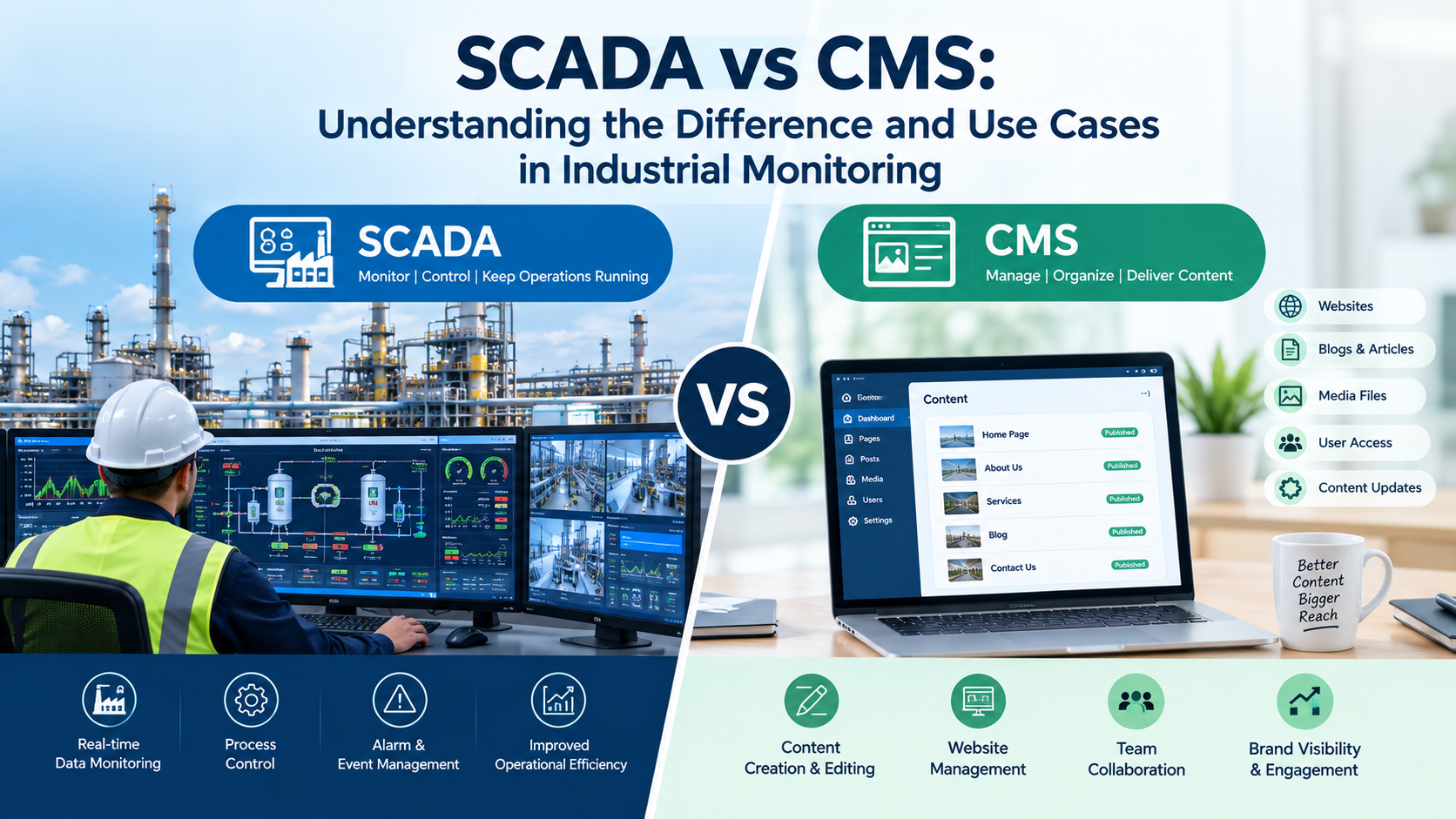
SCADA vs CMS: Understanding the Difference and Use Cases in Industrial Monitoring
SCADA vs CMS explained, learn the key differences, real-world use cases, and how to choose the right monitoring system for your renewable energy plant.
Introduction
If you run a wind farm, solar plant, or any industrial facility, you've probably heard both terms thrown around, SCADA and CMS. They sound similar. Both involve monitoring. Both use sensors and data. But they are not the same thing, and using the wrong one, or assuming one replaces the other, can cost you in downtime, missed faults, and poor asset performance.
This confusion is common, especially among renewable energy companies, wind farm owners and operators, solar plant owners, EPC companies, power generation companies, and O&M teams who are evaluating monitoring solutions for the first time or upgrading an aging setup.
In this guide, we'll break down SCADA vs CMS in plain language: what each system does, how they differ, where each one fits best, and how they actually work better together than apart. By the end, you'll know exactly which system (or combination) your plant needs.
What Is SCADA?
SCADA (Supervisory Control and Data Acquisition) is a control system used to monitor and manage entire industrial operations in real time. Think of SCADA as the central nervous system of a plant, it collects data from multiple devices, sensors, and PLCs (Programmable Logic Controllers), then presents that data on a single dashboard so operators can see and control the whole operation from one place.
Key Functions of a SCADA System
- Data acquisition from turbines, inverters, meters, and sensors across the site
- Real-time industrial monitoring of voltage, current, temperature, wind speed, and output
- Remote monitoring system capability, operators can supervise assets from anywhere
- Control functions, starting, stopping, or adjusting equipment remotely
- Alarm management for faults, trips, or abnormal readings
- Historical data logging for compliance, reporting, and performance analysis
A SCADA control system is not just about watching numbers, it's about acting on them. If a wind turbine's gearbox temperature spikes, SCADA can trigger an automatic shutdown or alert before failure occurs.
What Is CMS?
CMS (Condition Monitoring System) is a specialized system focused on tracking the health of specific mechanical components, usually rotating equipment like gearboxes, bearings, and main shafts in wind turbines, or motors and pumps in solar and industrial plants.
Unlike SCADA, which oversees the whole plant, a CMS monitoring system zooms in on component-level conditions through vibration analysis, oil analysis, acoustic emission, and thermal data.
Key Functions of a CMS
- Vibration monitoring on turbine gearboxes, bearings, and generators
- Early fault detection, catching wear, misalignment, or imbalance before breakdown
- Predictive maintenance data to schedule repairs before failure
- Trend analysis over weeks or months to track component degradation
- Reduced unplanned downtime by flagging issues days or weeks in advance
In short, a condition monitoring system tells you how healthy your equipment is, not just whether it's running.
SCADA vs CMS: The Core Difference
Here's the simplest way to understand the SCADA and CMS difference:
| Aspect | SCADA | CMS |
|---|---|---|
| Primary Purpose | Plant-wide supervision and control | Component-level health monitoring |
| Scope | Entire facility (turbines, inverters, grid connection) | Specific mechanical parts (bearings, gearboxes, shafts) |
| Data Type | Operational data (output, voltage, status) | Condition data (vibration, temperature trends, wear) |
| Main Goal | Real-time control and operational visibility | Predictive maintenance and fault prevention |
| Response | Immediate control actions and alarms | Long-term trend-based maintenance planning |
| Typical Users | Plant operators, control room staff | Maintenance and reliability engineers |
This SCADA and CMS comparison shows they aren't competitors, they solve different problems. SCADA answers "What is happening right now across my plant?" CMS answers "Is this specific component wearing out?"
SCADA System Use Cases
A SCADA system for industrial monitoring is essential wherever operations are spread across a large area or involve multiple interconnected assets.
1. Wind Farm Operations
SCADA aggregates data from every turbine on-site, output, wind speed, pitch angle, and fault codes, into one dashboard, letting operators manage dozens or hundreds of turbines remotely.
2. Solar Plant Management
For solar plants, SCADA tracks inverter performance, string-level output, and grid synchronization, helping O&M teams spot underperforming strings quickly.
3. Power Generation & Grid Integration
SCADA applications extend to substations and grid interconnection points, ensuring stable power flow and compliance with grid codes.
4. EPC Project Commissioning
During commissioning, EPC companies use SCADA to validate that all equipment communicates correctly and performs to design specifications before handover.
CMS System Use Cases
A CMS for condition monitoring shines in asset-heavy environments where mechanical failure is costly and hard to predict visually.
1. Wind Turbine Gearbox and Bearing Monitoring
Gearbox failure is one of the most expensive wind turbine repairs. CMS applications catch early-stage wear through vibration signatures, often weeks before a breakdown.
2. Generator Health Tracking
Continuous monitoring of generator bearings and windings helps avoid costly unplanned outages.
3. Predictive Maintenance Programs
O&M companies use CMS data to shift from reactive ("fix it when it breaks") to predictive maintenance, planning repairs during scheduled downtime instead of emergency shutdowns.
4. Warranty and Insurance Compliance
Many turbine OEM warranties and insurance policies now require documented condition monitoring data as proof of proper asset care.
Why Renewable Energy Companies Need Both
Here's the real-world insight most vendors won't tell you: SCADA and CMS work best as a combined system, not a choice between the two.
- SCADA gives you operational visibility and control, output, uptime, and grid performance.
- CMS gives you mechanical foresight, catching failures before they cause downtime.
A wind farm relying only on SCADA might see a turbine trip and shut down, but won't know why the gearbox failed until it's too late. A plant relying only on CMS will catch the mechanical issue but won't have real-time control over plant-wide operations.
Integrating both into a single remote monitoring system gives operators a complete picture: real-time control plus predictive insight. This integrated approach is increasingly the industry standard across renewable energy monitoring in India and globally, as asset owners push to reduce downtime and extend equipment life in an increasingly competitive power generation market.
How to Choose Between SCADA, CMS, or Both
Ask yourself these questions:
- Do you need real-time control of multiple assets across a site? → You need SCADA.
- Are you worried about mechanical wear in turbines, gearboxes, or motors? → You need a CMS.
- Do you manage a wind farm, solar plant, or hybrid renewable asset at scale? → You likely need both, integrated into one platform.
- Are you an EPC or O&M company managing multiple client sites? → An integrated SCADA and CMS setup simplifies reporting, reduces manual site visits, and strengthens client trust through transparent performance data.
Why GEISPL Is the Right Partner for SCADA & CMS Integration?
At GEISPL (geispl.in), based in Bangalore, we specialize in SCADA and CMS integration built specifically for renewable energy assets, wind and solar. We understand that renewable energy companies, wind farm and solar plant owners, EPC firms, power generation companies, and O&M teams don't just need software, they need a monitoring partner who understands turbine mechanics, grid compliance, and the operational pressures of running assets at scale.
Our team designs integrated SCADA control systems and condition monitoring systems that work together, giving you real-time industrial monitoring alongside predictive maintenance intelligence, all from a single remote monitoring platform. Whether you're commissioning a new wind farm, retrofitting an aging solar plant, or building an O&M program for multiple sites, GEISPL brings the technical depth to get it right the first time.
Frequently Asked Questions (FAQs)
1. What is the main difference between SCADA and CMS?
SCADA monitors and controls entire plant operations in real time, while CMS focuses specifically on tracking the mechanical health of components like bearings and gearboxes to predict failures early.
2. Can SCADA and CMS work together?
Yes. In fact, most renewable energy plants get the best results by integrating both, SCADA for operational control and CMS for predictive maintenance, into one unified monitoring system.
3. Is CMS only used for wind turbines?
No. While CMS is widely used for wind turbine gearboxes and bearings, it also applies to motors, pumps, generators, and other rotating equipment across industrial and solar applications.
4. Do solar plants need a CMS system?
Solar plants have fewer moving parts than wind turbines, so CMS use is more limited, usually applied to inverter cooling fans, trackers, and other mechanical components, while SCADA remains the primary monitoring tool for solar sites.
5. How does SCADA help with remote monitoring?
SCADA enables operators to view real-time data, receive alarms, and control equipment from anywhere, reducing the need for constant on-site staff and improving response times to faults.
6. Why is condition monitoring important for O&M companies?
Condition monitoring lets O&M companies plan maintenance ahead of failures rather than reacting to breakdowns, reducing repair costs, extending equipment life, and improving service reliability for clients.
Conclusion
Understanding the difference in the SCADA vs CMS debate comes down to one thing: SCADA controls and supervises your entire operation, while CMS protects the mechanical health of your most critical components. Neither replaces the other, together, they form a complete industrial monitoring strategy.
If you're a wind farm owner, solar plant operator, EPC company, or O&M provider looking to reduce downtime and extend asset life, the smartest move is integrating both systems into one reliable platform.
Ready to build a smarter monitoring strategy for your renewable energy assets? Visit GEISPL today to see how our SCADA and CMS integration solutions can help you monitor, predict, and protect your plant performance, all from one platform.
Category: SCADA