
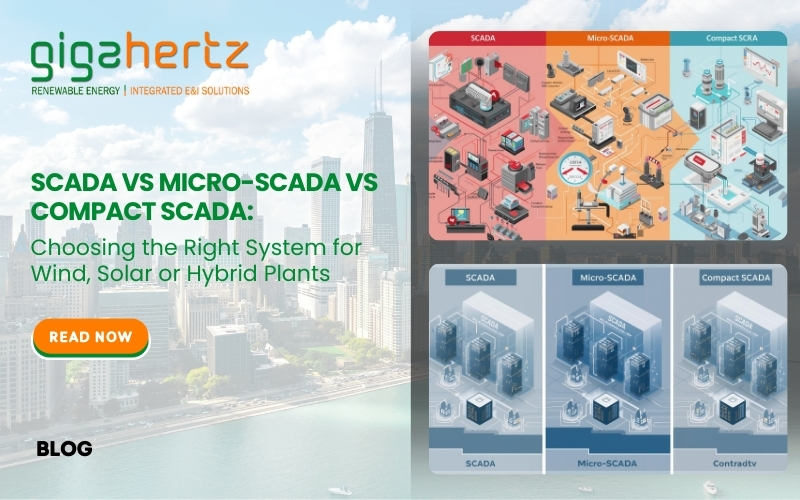
As renewable energy assets scale across India and globally, the need for real-time monitoring, automation, data analytics, and performance optimization has become critical. Whether you operate wind turbines, solar PV plants, substations, or large hybrid renewable parks, choosing the right SCADA architecture directly impacts energy yield, asset reliability, grid compliance, and operational efficiency.
But many asset owners still ask:
???? What is the difference between SCADA, Micro-SCADA, and Compact SCADA?
???? Which system is best for wind farms, solar plants, or hybrid (Wind + Solar + Storage) systems?
???? How do I choose the most cost-effective yet scalable solution?
This blog breaks down the differences in simple, practical terms and explains how GEISPL delivers tailored SCADA solutions for modern renewable energy operations.
What is SCADA? (Supervisory Control And Data Acquisition)
A full-scale SCADA system is an enterprise-level supervisory platform used in large and complex energy installations. It provides:
-
Real-time monitoring of all plant assets
-
Supervisory control of equipment and parameters
-
Historical data logging
-
Predictive alerts
-
Remote operation capabilities
-
Integration with turbines, inverters, substations, BESS & meteorological sensors
Where Full SCADA is Used
✔ Large wind farms (50 MW – 500 MW)
✔ Solar parks (100 MW and above)
✔ Hybrid renewable projects
✔ Utility-scale substations
✔ Transmission monitoring
Key Features
-
Centralized control room
-
High-volume data acquisition
-
Redundant architecture (N+1)
-
Multi-protocol interoperability (IEC-104, Modbus, OPC-UA, DNP3)
-
Advanced reporting & analytics
What is Micro-SCADA?
Micro-SCADA is a lighter, more cost-efficient version of full SCADA. It is suitable for mid-sized renewable projects that need powerful monitoring but do not require enterprise-level redundancy or complex control rooms.
Where Micro-SCADA is Used
✔ Medium-scale wind farms (10–50 MW)
✔ Solar plants (5–50 MW)
✔ Small substations
✔ Sites where OPEX needs to be optimized
Key Features
-
Real-time monitoring of key parameters
-
Basic control functions
-
Simplified architecture
-
Essential alarms & notifications
-
Moderate data storage capacity
-
Easy integration with OEM equipment
What is Compact SCADA?
Compact SCADA is the smallest and most optimized system—ideal for rooftop solar, small wind installations, microgrids, and distributed renewable systems. It focuses on monitoring rather than full control.
Where Compact SCADA is Used
✔ Rooftop solar systems
✔ Small C&I solar plants (500 kW – 5 MW)
✔ Distributed wind systems
✔ Microgrids
✔ Small hybrid systems (Wind + Solar + BESS at small scale)
Key Features
-
Compact hardware footprint
-
Essential dashboards
-
Basic alarms
-
Low data capture frequency
-
Extremely cost-efficient
-
Cloud-enabled monitoring
Side-by-Side Comparison: SCADA vs Micro-SCADA vs Compact SCADA
| Feature | Full SCADA | Micro-SCADA | Compact SCADA |
|---|---|---|---|
| Project size | Large wind/solar/hybrid | Medium wind/solar | Small DG, rooftop, microgrid |
| Cost level | High | Moderate | Low |
| Data frequency | High (sec-level) | Medium | Low |
| Data storage | Long-term historical | Basic historical | Limited |
| Control capability | Full control | Partial control | Mostly monitoring |
| Redundancy | Yes | Optional | No |
| Integration | Turbines, inverters, BESS, substations | Limited OEM integration | Basic device integration |
Which SCADA System Does Your Renewable Plant Need?
Choosing the right system depends on multiple parameters:
1. Plant Size (MW Capacity)
Large plants → Full SCADA
Medium plants → Micro-SCADA
Small plants → Compact SCADA
2. Asset Type
| Type | Recommended |
|---|---|
| Wind farm | Full SCADA / Micro-SCADA |
| Solar park | Full SCADA / Micro-SCADA |
| Rooftop solar | Compact SCADA |
| Hybrid renewable plant | Full SCADA |
| BESS & Substations | Full SCADA |
3. Operational Needs
If you require:
✔ High-resolution data
✔ Predictive analytics
✔ Remote command execution
✔ Redundancy
→ Go for Full SCADA
If you need simplified monitoring with essential alerts
→ Micro-SCADA is ideal
If you only need basic dashboards and alarms
→ Compact SCADA is more than sufficient
4. Budget Constraints
Full SCADA provides maximum value
Micro-SCADA reduces both CAPEX & OPEX
Compact SCADA is the most affordable
SCADA for Wind, Solar & Hybrid Plants: Why It Matters
Wind Farms
-
Turbine performance tracking
-
Power curve analysis
-
Yaw, pitch, gearbox, and nacelle monitoring
-
Weather & wind speed integration
-
Curtailment and grid compliance
Solar Plants
-
Inverter & string performance
-
Solar irradiance mapping
-
Soiling loss detection
-
String-level alarms
-
PR (Performance Ratio) optimization
Hybrid + BESS Projects
-
Combined wind + solar dashboard
-
Battery SOC, SOH & dispatch control
-
Real-time energy flow visibility
-
Grid services & peak management
How GEISPL Helps You Choose the Right SCADA System
GEISPL delivers end-to-end SCADA and monitoring solutions for the renewable energy sector with:
✔ Custom SCADA for Wind, Solar & Hybrid
We design solutions aligned to plant size, complexity & OEM compatibility.
✔ SCADA + CMS + BESS Integration
Single dashboard for:
-
Wind turbines
-
Solar inverters
-
Substations
-
Energy Storage Systems (BESS)
✔ Predictive Analytics & Condition Monitoring
Reduce downtime and improve asset lifecycle.
✔ Central & Remote Monitoring Capabilities
Access from control rooms or cloud dashboards.
✔ Scalable Architecture
Upgrade from compact → micro → full SCADA as the plant expands.
Conclusion
SCADA, Micro-SCADA, and Compact SCADA each serve different operational and economic needs.
The right choice depends on plant size, performance goals, integration complexity, and budget.
For wind, solar, and hybrid renewable plants, selecting the correct SCADA platform ensures:
✔ Better energy yield
✔ Higher reliability
✔ Faster fault detection
✔ Lower O&M cost
✔ Greater ROI
With GEISPL’s expertise in SCADA, CMS, Hybrid Monitoring, and BESS integration, renewable asset owners can seamlessly deploy the ideal system for their operations.
Category: SCADA