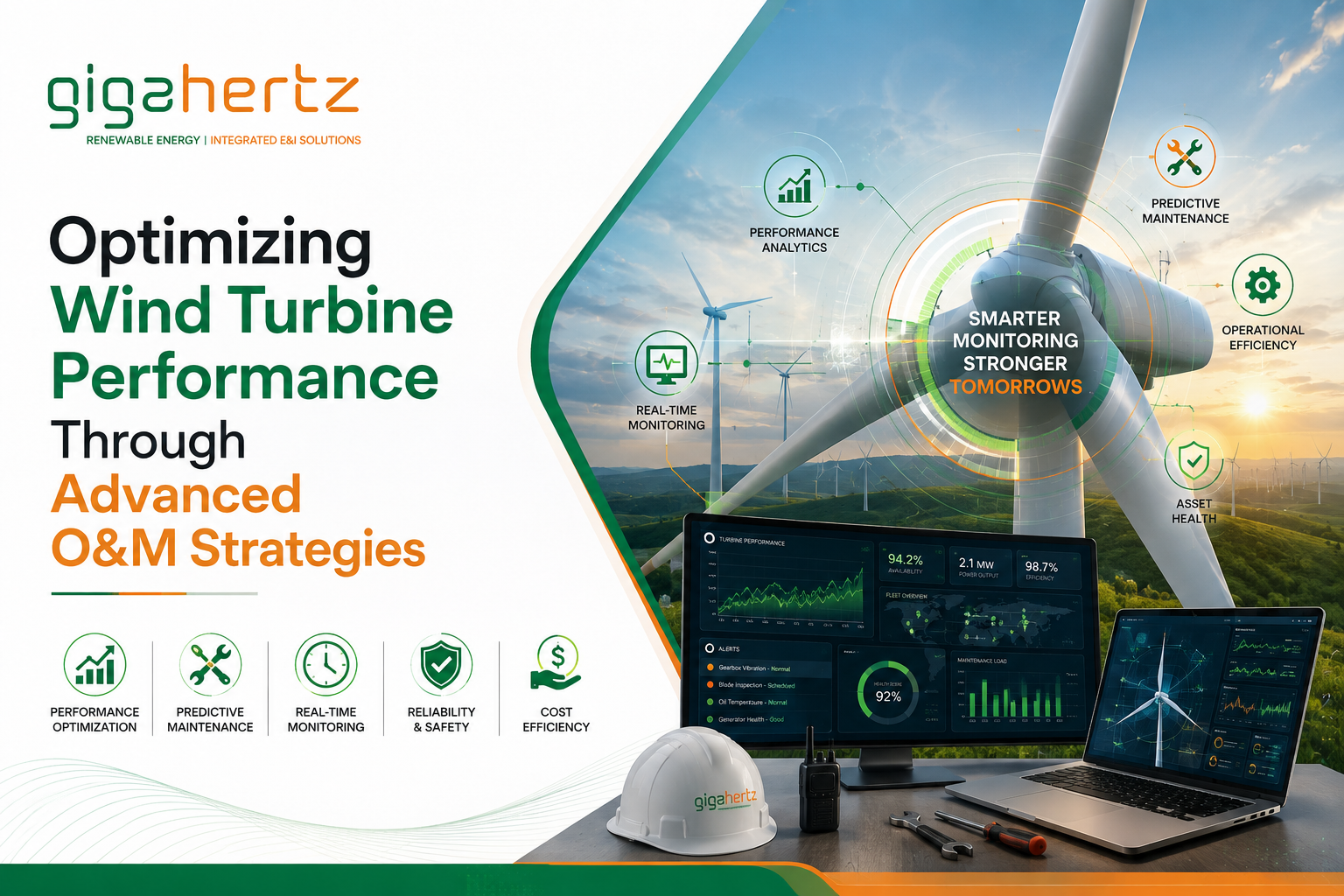
Optimizing Wind Turbine Performance Through Advanced O&M Strategies
Wind energy has moved past its early growth phase and into a stage where performance, not just capacity addition, defines success. Every megawatt-hour lost to unplanned downtime, delayed spare parts, or an underperforming maintenance contract is revenue that never comes back. For asset owners, developers, and operations teams, Operations & Maintenance (O&M) is no longer a background function handled quietly after commissioning; it has become one of the most powerful levers for protecting returns across the lifetime of a wind asset.
This shift is being driven by a mix of pressures: tightening margins, longer lead times for critical components, a shortage of skilled field technicians, and growing frustration with rigid, opaque OEM service contracts. Operators who once accepted a "set it and forget it" approach to maintenance are now actively rethinking how their fleets are managed, monitored, and supported. The result is a new generation of O&M strategy — one built on data, flexibility, and closer collaboration between owners and specialist technical partners.
This guide walks through what advanced wind turbine O&M actually involves, the strategic models operators are choosing between, the digital and engineering foundations that make those models work, and the practical steps a wind farm operator can take to build a more resilient, performance-driven maintenance program.
What Does Wind Turbine O&M Really Mean Today?
Operations & Maintenance covers everything required to keep a wind turbine and the wider wind farm infrastructure around it running safely, reliably, and at optimal output. That includes routine servicing, condition monitoring, fault diagnosis, spare parts management, SCADA and control system upkeep, and the strategic decisions around who performs each of these tasks and how.
Traditionally, O&M was treated as a fixed cost: a service contract signed with the turbine OEM, renewed year after year with little scrutiny. Today, forward-looking operators treat O&M as an active discipline, one that directly shapes asset availability, energy yield, and the total cost of ownership across the project's operating life. The strategic question has shifted from "how do we keep the turbines turning" to "how do we extract maximum reliable output from every asset in the fleet, for as long as possible."
The Pressures Reshaping Modern O&M Strategy
Several converging factors are pushing operators to reassess how their fleets are maintained:
Extended lead times for critical components. Blades, gearboxes, bearings, and control system parts can take a long time to source, especially in emerging wind markets where customs and logistics add further delay. A reactive maintenance approach leaves fleets exposed to extended outages whenever a major component fails without warning.
A shrinking pool of skilled technicians. Experienced wind technicians, particularly those trained on legacy turbine platforms and control systems, are difficult to find and retain. This scarcity increases both cost and safety risk, and it puts pressure on operators to standardize and simplify field work wherever possible.
Limited transparency from full-service contracts. Long-term, OEM-managed service agreements offer predictability, but they often come with limited visibility into actual turbine health, inflexible terms, and little incentive for the service provider to push performance beyond the contracted baseline. Owners increasingly want independent insight into their own assets rather than relying solely on OEM-reported data.
Legacy systems and data silos. Many wind farms, especially those built in earlier development waves, run on aging SCADA platforms, disconnected control panels, and monitoring tools that don't talk to one another. Without a unified data layer, it becomes very difficult to spot early warning signs of component degradation or to benchmark performance across a fleet.
Choosing the Right O&M Model
Most operators today are weighing three broad approaches to managing their fleet, and each comes with distinct trade-offs.
Full-Service (OEM-Managed) Contracts
Under a full-service or "full wrap" agreement, the turbine manufacturer handles nearly all maintenance activity under a long-term contract. This model offers predictable costs and low administrative burden, which makes it attractive to owners without a large in-house technical team. The trade-off is reduced control: contract terms are often rigid, data transparency can be limited, and the incentive structure doesn't always align with maximizing availability beyond the guaranteed minimum.
Hybrid O&M
A hybrid model blends outsourced specialist support with in-house oversight. Operators typically retain control over strategic decisions, condition monitoring, and major component planning, while outsourcing routine servicing or specific technical tasks to trusted partners. This approach lets an operator build internal expertise gradually without taking on the full operational burden of a self-perform model, and it's increasingly popular among operators who want more visibility into their assets without walking away entirely from specialist support.
Self-Perform
In a self-perform model, the asset owner takes full responsibility for maintenance, using an internal team supported by external partners for spares, engineering support, and specialized services. This approach offers the greatest control over cost, KPIs, and data, and can deliver the lowest long-term operating cost for operators with sufficient scale. It does, however, demand significant internal capability — trained technicians, robust spare parts logistics, and dependable monitoring and control infrastructure.
There is no universally "correct" model. The right choice depends on fleet size, geography, in-house technical maturity, and how much control an operator wants over day-to-day asset performance. What all three models share, however, is a growing reliance on strong digital infrastructure — dependable SCADA systems, real-time monitoring, and integrated control panels — as the foundation that makes any O&M strategy actually work.
Digital Infrastructure: The Real Foundation of Performance
Regardless of which O&M model an operator chooses, the fleets performing best today share one thing in common: they treat digital infrastructure as core to operations, not as an optional add-on.
SCADA and Real-Time Monitoring
A dependable SCADA platform is the nervous system of a wind farm. It's what allows an operations team to see turbine status, environmental conditions, power output, and fault codes in real time, and to respond before a minor issue becomes a costly failure. Operators running older or fragmented SCADA and compact SCADA setups often struggle with exactly the kind of blind spots that lead to unplanned downtime, which is why many fleets are prioritizing SCADA modernization as a first step in any O&M overhaul.
Control Panels and Measurement Systems
Reliable turbine performance also depends on the health of the underlying control panel infrastructure and precise measurement systems that feed accurate data back into monitoring platforms. Inconsistent or degraded measurement hardware quietly undermines even the best monitoring software, since decisions are only as good as the data behind them.
IoT-Enabled Condition Monitoring
Beyond SCADA, many operators are layering in IoT-enabled monitoring services to track component-level health — vibration, temperature, and load patterns on critical drivetrain and rotor components. This kind of continuous, connected monitoring shifts maintenance planning from a fixed calendar schedule toward a condition-based approach, where intervention happens based on actual asset health rather than a generic timetable.
Hardware Programming and System Integration
As fleets mix turbine models, vintages, and control architectures, the ability to program, configure, and integrate control hardware becomes essential. Specialist hardware programming support ensures that control panels, PLCs, and monitoring systems across a mixed fleet can actually communicate with each other, closing the data silos that hold back predictive maintenance efforts.
Asset Management and Spares: Closing the Loop
Digital visibility only pays off if it's backed by a strong operational support structure. Two areas matter most here.
Structured Asset Management
A structured asset management approach ties together monitoring data, maintenance history, and component life-cycle planning into a single strategic view of the fleet. Rather than reacting to failures individually, operators with mature asset management practices can plan interventions proactively, prioritize the turbines and components that carry the greatest risk, and make informed decisions about when to repair, upgrade, or replace.
Spares and Repairs Readiness
Extended component lead times make spares strategy a genuine competitive differentiator. Operators who maintain strong relationships with spares and repairs partners, and who plan critical spares inventory around known failure modes, are far better positioned to turn a component failure into a short, manageable repair rather than a prolonged outage.
Building an Advanced O&M Strategy: A Practical Framework
Bringing all of this together, an advanced O&M strategy generally follows a consistent pattern:
- Establish a single source of truth. Consolidate SCADA, condition monitoring, and maintenance records so the operations team is working from unified, trustworthy data rather than disconnected systems.
- Shift from calendar-based to condition-based maintenance. Use real-time monitoring data to prioritize interventions based on actual component health rather than a fixed schedule.
- Reassess the O&M model periodically. As internal capability grows and market conditions shift, the right balance between full-service, hybrid, and self-perform approaches can change. Treat the O&M model as a strategic decision to revisit, not a one-time choice.
- Invest in workforce and system readiness. Whether maintenance is performed in-house or through partners, ensure control systems, SCADA platforms, and hardware are standardized and well-documented so that technicians of varying experience levels can work efficiently and safely.
- Plan spares strategically. Map critical components against known failure modes and lead times, and build relationships with reliable wind energy solutions partners who can support fast turnaround when it matters most.
- Treat R&D and continuous improvement as part of O&M. Fleets that invest in ongoing R&D in industrial automation consistently find new ways to reduce downtime, extend component life, and improve control system resilience over time.
Frequently Asked Questions
What is the difference between preventive and condition-based maintenance in wind turbines?
Preventive maintenance follows a fixed schedule regardless of actual component condition, while condition-based maintenance uses real-time monitoring data — vibration, temperature, load, and SCADA signals — to trigger interventions only when a component genuinely shows signs of wear. Condition-based approaches generally reduce both unnecessary servicing and the risk of unexpected failures.
Which O&M model is best for a wind farm operator?
There is no single best model. Full-service contracts suit operators who prioritize predictability and have limited in-house technical capacity. Hybrid models suit operators looking to build internal expertise while retaining specialist support for complex tasks. Self-perform models suit larger, more mature operators with the internal capability to manage day-to-day maintenance directly.
Why is SCADA important for wind turbine performance optimization?
SCADA systems provide the real-time visibility needed to detect faults early, track turbine and component performance, and make informed maintenance decisions. Without dependable SCADA infrastructure, condition-based maintenance and predictive strategies simply aren't possible.
How does asset management improve wind turbine reliability?
Structured asset management combines monitoring data, service history, and component life-cycle information into a single strategic view, allowing operators to plan interventions proactively and prioritize the assets and components carrying the greatest performance risk.
Final Thought
The wind operators pulling ahead today aren't necessarily the ones with the newest turbines — they're the ones who have rebuilt their O&M strategy around real-time data, condition-based decision-making, and dependable digital and engineering infrastructure. Whether an operator chooses a full-service, hybrid, or self-perform path, the underlying requirement is the same: reliable SCADA and control systems, strong asset management practices, and a spares strategy built for resilience.
Building that kind of foundation doesn't have to happen alone. Partnering with a technical specialist who understands SCADA, control panel engineering, IoT-enabled monitoring, and spares support can turn O&M from a reactive cost center into the strategic advantage it's capable of being. With over a decade of hands-on experience engineering SCADA, control panel, and industrial automation solutions for wind assets, GEISPL helps operators build exactly this kind of resilient, performance-driven O&M foundation — from real-time monitoring to spares readiness and beyond.
Category: SCADA