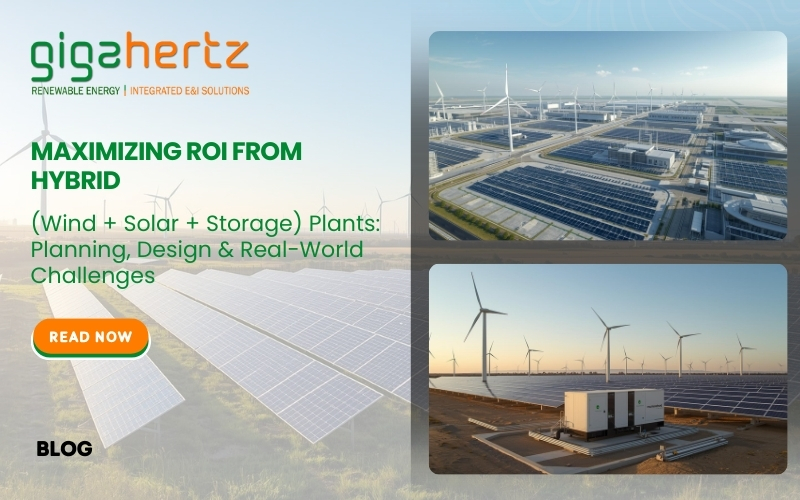
Hybrid renewable energy systems—especially Wind + Solar + Battery Energy Storage Systems (BESS)—are transforming the global energy landscape. As power producers look for higher reliability, improved CUF, reduced intermittency, and better revenue models, hybridization has become a strategic priority.
For Independent Power Producers (IPPs), OEMs, DISCOMs, and renewable asset owners, the key question today is:
How do we maximize ROI from hybrid power plants while ensuring long-term performance and grid compliance?
This blog explores the planning strategies, engineering design considerations, operational insights, and real-world challenges of hybrid renewable plants, along with how companies like GEISPL support end-to-end lifecycle optimization through O&M, SCADA, CMS, and BESS integration technologies.
Why Hybrid (Wind + Solar + Storage) Plants Are the Future
Hybrid renewable systems offer several economic and operational benefits such as:
-
Higher Capacity Utilization Factor (CUF)
-
Improved grid stability and smoother power output
-
Reduced curtailment and peak-hour penalties
-
Better utilization of transmission infrastructure
-
Revenue from multiple market mechanisms (DAM, RTM, ancillary services, peak-shaving)
-
Flexibility to meet PPA demands and deviation settlement regulations (DSM)
SEO Keywords:
Hybrid renewable energy plant, Wind-solar hybrid system, BESS integration, maximize renewable ROI, hybrid energy storage solutions, hybrid power plant optimization, wind solar storage India, hybrid plant economics.
1. Strategic Planning for Hybrid Renewable Plants
A successful hybrid plant begins with data-driven planning. The following factors influence energy yield, grid compliance, and ROI.
1.1 Resource Assessment
-
Wind speed distribution
-
Solar irradiance (GHI/DNI)
-
Seasonal variation
-
Terrain and micro-siting
-
Shadow analysis and tower wake effects
Wind speed distribution
Solar irradiance (GHI/DNI)
Seasonal variation
Terrain and micro-siting
Shadow analysis and tower wake effects
Long-tail Keywords:
renewable resource assessment tools, wind solar hybrid design planning, hybrid plant feasibility study.
2. Engineering & Design Optimization for Maximum ROI
A hybrid plant's ROI is directly tied to the effectiveness of its design.
2.1 System Sizing & Capacity Mix
Choosing the right ratio of wind:solar:battery is critical.
Common configurations include:
-
60% Wind + 30% Solar + 10% BESS
-
50% Wind + 35% Solar + 15% BESS
-
Custom sizing based on PPA, grid code, and load profile
Design Considerations:
-
Wind generation peaks during evenings & monsoon
-
Solar peaks during daytime
-
Battery compensates during ramp-up/ramp-down
2.2 Grid & Power Evacuation Planning
-
Substation load flow study
-
Transformer and switchgear sizing
-
Harmonics and reactive power management
-
Compliance with CEA grid regulations
Substation load flow study
Transformer and switchgear sizing
Harmonics and reactive power management
Compliance with CEA grid regulations
2.3 SCADA & Hybrid Plant Control System
A robust hybrid SCADA system ensures accurate monitoring and forecasting by integrating:
-
Wind Turbine Data
-
Solar string inverter data
-
Battery management system (BMS)
-
Weather sensors
-
ESP, USS, PSS, CMS, and substation performance metrics
Tech Keywords:
Hybrid SCADA, renewable energy monitoring system, WASP, turbine SCADA, solar SCADA integration, GEISPL SCADA solutions.
3. Battery Energy Storage (BESS): The Core of Hybrid Optimization
3.1 Why BESS is Critical
Storage allows hybrid plants to:
-
Reduce intermittency
-
Participate in ancillary services
-
Perform peak shaving
-
Improve grid stability
-
Avoid DSM penalties
3.2 BESS Sizing Factors
-
Depth of discharge
-
Round-trip efficiency
-
Cycle life
-
C-rate
-
Use-case (peak shaving, shifting, smoothing, black start, reserve capacity)
Depth of discharge
Round-trip efficiency
Cycle life
C-rate
Use-case (peak shaving, shifting, smoothing, black start, reserve capacity)
3.3 Safety & Compliance
-
Fire suppression systems
-
Cell balancing
-
Thermal management
-
EMS + SCADA Integration
Fire suppression systems
Cell balancing
Thermal management
EMS + SCADA Integration
LSI Keywords:
battery energy storage ROI, hybrid plant BESS India, energy storage for wind solar hybrid, lithium-ion BESS safety.
4. Real-World Challenges in Hybrid (Wind + Solar + Storage) Plants
Even though hybrid systems are the future, the industry faces several complexities.
4.1 Forecasting & Scheduling
-
High variance in wind profiles
-
Cloud cover prediction errors
-
Need for AI-based forecasting models
High variance in wind profiles
Cloud cover prediction errors
Need for AI-based forecasting models
4.2 Asset Management & O&M
Wind turbines require mechanical maintenance, while solar plants need electrical and cleaning cycles.
Challenges include:
-
Blade damage, gearbox failure, yaw issues
-
Panel soiling and inverter derating
-
Cable losses and earthing issues
-
Substation outages
-
Delay in spare parts and inventory management
4.3 Grid & Compliance Challenges
-
Transmission line congestion
-
Curtailment
-
Low-voltage ride-through (LVRT) requirements
-
Reactive power and harmonics management
Transmission line congestion
Curtailment
Low-voltage ride-through (LVRT) requirements
Reactive power and harmonics management
4.4 SCADA & Data Integration Challenges
-
Disparate OEM systems
-
Communication protocol challenges (Modbus, OPC-UA, IEC-104)
-
Data inconsistency
-
Lack of real-time optimization
Disparate OEM systems
Communication protocol challenges (Modbus, OPC-UA, IEC-104)
Data inconsistency
Lack of real-time optimization
4.5 BESS Challenges
-
Thermal runaway
-
Degradation over time
-
EMS optimization
Thermal runaway
Degradation over time
EMS optimization
SEO Keywords:
renewable O&M challenges, hybrid plant grid integration issues, wind solar hybrid India challenges, BESS operational issues.
5. How GEISPL Helps Improve ROI Through Technology & O&M Excellence
GEISPL provides integrated solutions for the renewable industry, making hybrid plants more reliable, efficient, and profitable.
5.1 SCADA & CMS Custom Solutions
-
Real-time monitoring for wind turbines, solar plants & substations
-
Hybrid dashboards for Wind + Solar + BESS
-
Predictive analytics & anomaly detection
-
Custom alerts for breakdown prevention
Real-time monitoring for wind turbines, solar plants & substations
Hybrid dashboards for Wind + Solar + BESS
Predictive analytics & anomaly detection
Custom alerts for breakdown prevention
5.2 O&M Parts Supply for Wind Turbines
GEISPL supports O&M operations with authentic nacelle, tower, PSS, USS, and substation components, ensuring:
-
Faster repair cycles
-
Reduced downtime
-
Improved turbine performance
5.3 BESS Enablement & Integration Support
-
EMS + SCADA integration
-
Performance monitoring
-
Battery diagnostics
-
Safety audit support
EMS + SCADA integration
Performance monitoring
Battery diagnostics
Safety audit support
5.4 Consulting for Hybrid Plant Design
-
Resource assessment
-
Hybrid system sizing
-
EPC technical advisory
-
Grid compliance assessment
Resource assessment
Hybrid system sizing
EPC technical advisory
Grid compliance assessment
Industry Keywords:
wind turbine O&M India, solar O&M solutions, hybrid SCADA provider, GEISPL renewable services, predictive maintenance wind turbines.
6. Key Strategies to Maximize ROI in Hybrid Renewable Plants
To get the highest financial return from hybrid assets, companies should focus on:
1. Accurate Wind + Solar Forecasting
AI and ML models reduce DSM penalties.
2. Optimized BESS Dispatch Strategy
Maximize revenue through market participation and peak-demand fulfillment.
3. Advanced SCADA-Driven Asset Intelligence
Digitization leads to lower downtime and better energy yield.
4. Lifecycle O&M Planning
Scheduled servicing + condition monitoring = higher turbine availability.
5. Data-Driven Performance Benchmarking
Benchmark by turbine, inverter, feeder, and substation.
6. Proactive Spare Parts Management
Ensures faster repairs and minimal loss of production.
Conclusion
Hybrid (Wind + Solar + Storage) power plants are the backbone of the future renewable energy ecosystem. With cost-competitive solar, steady wind generation, and increasingly affordable BESS solutions, hybridization delivers unmatched financial and operational benefits.
However, maximizing ROI requires precise planning, intelligent design, advanced SCADA systems, and reliable O&M support.
At GEISPL, we combine engineering expertise, monitoring technology, and on-ground operational excellence to help renewable asset owners optimize energy output, reduce downtime, and enhance long-term profitability.
Category: Energy plants