
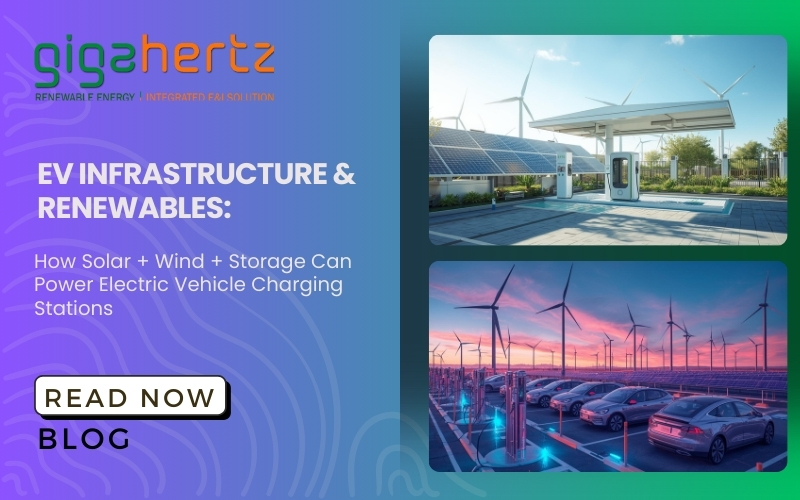
The rapid adoption of electric vehicles (EVs) is pushing the demand for reliable, affordable, and sustainable EV charging infrastructure. Traditional EV charging stations depend heavily on grid supply—often sourced from fossil fuels—leading to:
-
High operational costs
-
Unstable supply in remote areas
-
Grid overload during peak charging
-
Increased carbon footprint
This is why renewable-powered EV charging stations—especially those combining Solar + Wind + Battery Energy Storage Systems (BESS)—are emerging as the future of clean mobility.
In this blog, we explore how renewable energy sources can power EV charging infrastructure efficiently, sustainably, and profitably, and how GEISPL supports this transition with robust SCADA, monitoring, and storage integration solutions.
The Growing Need for Renewable-Powered EV Charging Stations
India’s EV market is expected to grow exponentially in the next decade, leading to high energy demand. However, traditional grid-only charging poses multiple challenges:
Challenges of Conventional EV Charging
-
High electricity tariffs
-
Grid instability and congestion
-
Carbon-intensive power supply
-
High peak demand charges
-
Limited feasibility in rural or highway locations
High electricity tariffs
Grid instability and congestion
Carbon-intensive power supply
High peak demand charges
Limited feasibility in rural or highway locations
Renewable EV charging stations solve these issues by leveraging solar PV, wind energy, and battery storage to create energy-independent, cost-efficient systems.
SEO Keywords:
renewable energy EV charging, solar-powered charging stations India, wind energy for EV charging, BESS for EV infrastructure, clean mobility solutions, hybrid renewable charging.
How Solar Energy Powers EV Charging Stations
Solar energy is the most widely used renewable source for EV charging due to its availability and scalability.
Benefits of Solar + EV Charging
-
Low operational cost
-
Modular scaling
-
Works well in urban & rural areas
-
Ideal for daytime charging
-
Integrates easily with rooftop and ground-mounted systems
Low operational cost
Modular scaling
Works well in urban & rural areas
Ideal for daytime charging
Integrates easily with rooftop and ground-mounted systems
Solar Use Cases for EV Infrastructure
-
Workplace charging
-
Commercial charging hubs
-
Highway charging stations
-
Residential EV charging
-
Metro station & airport EV bays
Workplace charging
Commercial charging hubs
Highway charging stations
Residential EV charging
Metro station & airport EV bays
How Wind Energy Supports EV Charging
Wind energy complements solar by generating power in evenings, nights, and monsoon seasons, making it an excellent secondary source for hybrid EV charging networks.
Advantages of Wind for EV Charging
-
Provides nighttime charging support
-
Works in areas with strong wind corridors
-
Useful for industrial charging depots
-
Adds diversity to renewable generation
-
Reduces dependency on solar-only systems
Provides nighttime charging support
Works in areas with strong wind corridors
Useful for industrial charging depots
Adds diversity to renewable generation
Reduces dependency on solar-only systems
Wind + Solar combinations enhance energy reliability and availability.
Why Battery Energy Storage (BESS) Is Essential for Renewable EV Charging
EV charging is a high-power, time-sensitive load, and renewables alone cannot meet demand consistently.
This makes BESS the backbone of renewable EV infrastructure.
Role of BESS in EV Charging Stations
-
Stores excess solar/wind power
-
Supplies energy during peak charging hours
-
Provides backup power during grid outages
-
Supports fast charging (DCFC)
-
Reduces demand charges
-
Enables off-grid or hybrid charging stations
Stores excess solar/wind power
Supplies energy during peak charging hours
Provides backup power during grid outages
Supports fast charging (DCFC)
Reduces demand charges
Enables off-grid or hybrid charging stations
Key BESS Benefits
-
Smooth power supply
-
High charging reliability
-
Reduced OPEX
-
Peak shaving
-
Renewable energy time-shifting
Smooth power supply
High charging reliability
Reduced OPEX
Peak shaving
Renewable energy time-shifting
Hybrid Solar + Wind + Storage Charging Stations: The Future of Clean Mobility
A combination of Solar + Wind + BESS offers unmatched operational and financial advantages:
1. 24/7 Power Availability
-
Solar supplies daytime energy
-
Wind covers evenings & nights
-
BESS bridges gaps & peak demand
Solar supplies daytime energy
Wind covers evenings & nights
BESS bridges gaps & peak demand
2. Lower Cost Per Charge
Renewables significantly reduce electricity costs for slow, fast, and ultra-fast charging.
3. Zero-Emission EV Infrastructure
Supports climate goals, sustainability certification, and green transport initiatives.
4. Reduced Grid Dependency
Ideal for:
-
Highway corridors
-
Rural charging locations
-
Logistic hubs
-
Remote EV stations
5. Enables Fast Charging (50 kW – 350 kW)
High-power chargers require stable, high-discharge energy—achievable through BESS.
Technical Architecture of a Renewable EV Charging Station
A modern renewable-powered EV station typically includes:
✔ Solar PV Array
Roof-mounted or ground-mounted based on available space.
✔ Small or Medium Wind Turbine (Optional)
Provides complementary generation during non-solar hours.
✔ Battery Energy Storage System (BESS)
Lithium-ion / LFP / flow batteries depending on lifecycle needs.
✔ EV Fast Chargers
AC Slow (3.3–22 kW)
DC Fast (30–60 kW)
DC Ultra-Fast (100–350 kW)
✔ SCADA & Energy Management System (EMS)
Controls energy dispatch, solar/wind availability, and battery cycles.
✔ Grid Connection (Optional)
For hybrid or backup support.
How GEISPL Supports EV Infrastructure with Renewable Energy Solutions
GEISPL enables energy-efficient EV infrastructure with:
1. SCADA for Solar, Wind & BESS
Unified monitoring for:
-
PV inverters
-
Wind turbines
-
BESS (SOC, SOH, discharge)
-
EV chargers
-
Substations
2. Custom Renewable Integration
We design hybrid solutions for:
-
EV charging hubs
-
Corporate EV stations
-
Public charging networks
-
Highway charging corridors
3. Predictive Analytics & Monitoring
-
Load forecasting
-
Renewable forecasting
-
Battery performance analytics
-
Fault & anomaly detection
Load forecasting
Renewable forecasting
Battery performance analytics
Fault & anomaly detection
4. BESS Advisory & Design
-
Sizing for EV loads
-
Peak shaving
-
Fast charging support
-
Backup energy
Sizing for EV loads
Peak shaving
Fast charging support
Backup energy
5. Solar & Wind O&M Support
-
Spare parts for wind turbines (nacelle, tower, USS, PSS)
-
Solar O&M, inverter monitoring, string-level analytics
Spare parts for wind turbines (nacelle, tower, USS, PSS)
Solar O&M, inverter monitoring, string-level analytics
The Financial Impact: Why Renewable EV Charging Stations Deliver Higher ROI
✔ Lowest Operating Cost
Renewable energy is significantly cheaper than grid electricity.
✔ Earn from Carbon Credits
Green charging stations qualify for sustainability incentives.
✔ Higher Reliability At Lower Cost
BESS reduces downtime and protects chargers from grid fluctuations.
✔ Scalability for Future EV Growth
Infrastructure can expand with charging demand.
✔ Enhanced Brand Value
Businesses offering renewable EV charging gain strong sustainability positioning.
Conclusion
The future of EV charging is renewable-powered, intelligent, and storage-enabled. Solar + Wind + BESS offers unmatched energy independence, cost savings, and sustainability—making it the ideal power architecture for EV charging stations.
With GEISPL’s expertise in SCADA systems, hybrid energy integration, condition monitoring, and storage solutions, EV charging operators can build smart, reliable, and future-ready infrastructure.
Want to Build a Renewable-Powered EV Charging Station?
GEISPL provides end-to-end solutions for:
✔ Solar & Wind Integration
✔ BESS Sizing & Design
✔ SCADA for Hybrid Charging Stations
✔ Predictive Analytics & Monitoring
✔ O&M & Spare Parts Support
???? Contact us today to explore renewable EV infrastructure solutions.
Category: EV