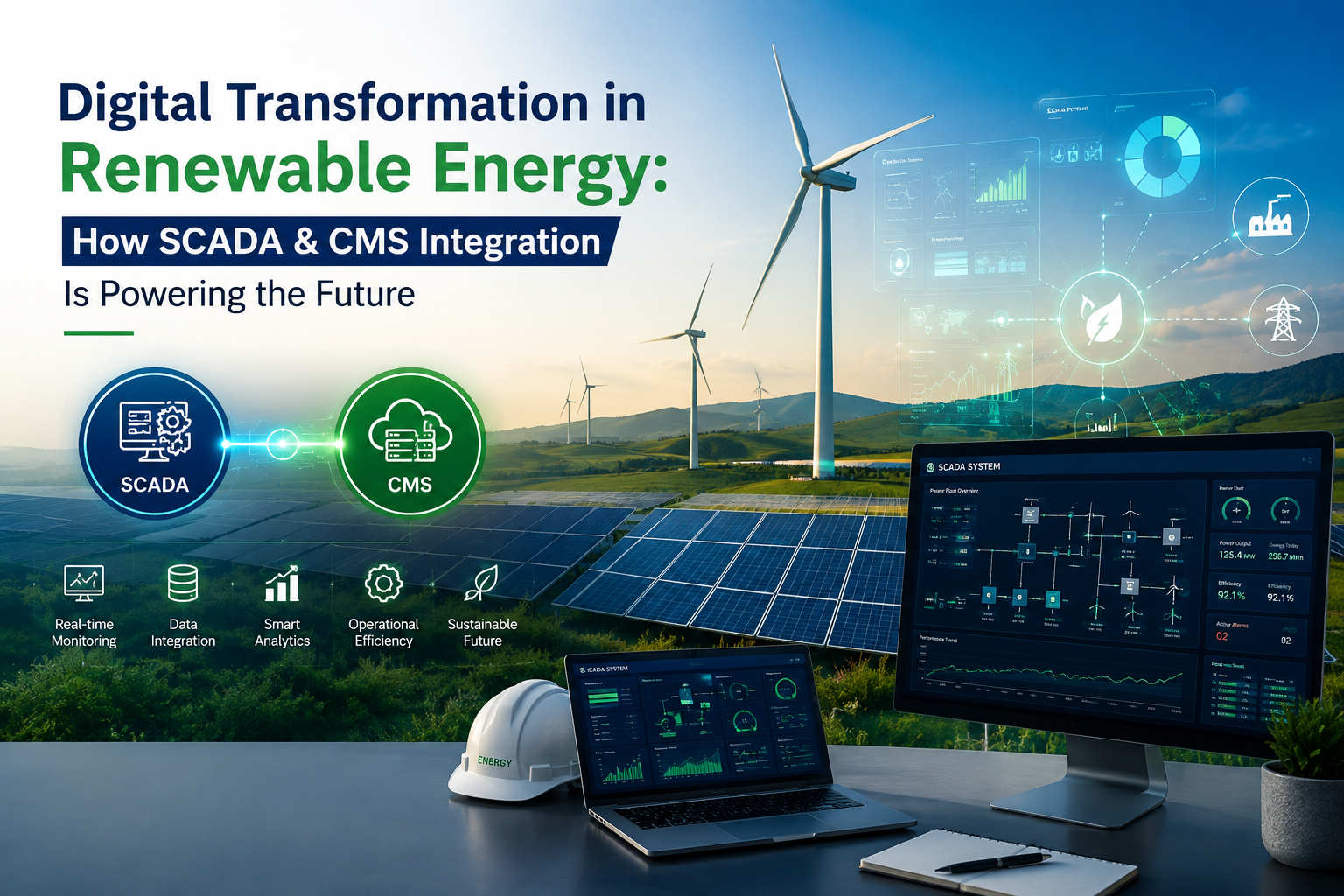
Digital Transformation in Renewable Energy: How SCADA & CMS Integration Is Powering the Future
Discover how digital transformation in renewable energy uses SCADA & CMS integration to boost efficiency, cut downtime, and maximize ROI. Learn more today.
Introduction: Why Renewable Energy Needs a Digital Upgrade
India's wind and solar capacity is growing every year. But bigger fleets bring bigger problems. Aging SCADA systems. Blind spots in turbine health. Manual reports that take days instead of minutes.
This is exactly why digital transformation in renewable energy has become a survival strategy, not a luxury. Asset owners who still rely on outdated monitoring tools are losing money to unplanned downtime, delayed fault detection, and inefficient maintenance planning.
The fix lies in two technologies working together: SCADA (Supervisory Control and Data Acquisition) and CMS (Condition Monitoring System). When integrated properly, they give operators a single, real-time view of plant health, from turbine gearboxes to inverter performance.
At GEISPL, based in Bangalore, we've worked closely with wind farm owners, solar plant operators, EPC companies, and O&M teams to bridge this exact gap. This blog breaks down what digital transformation really means for renewable energy, how SCADA and CMS integration works, and why it's becoming the backbone of modern power generation.
What Is Digital Transformation in Renewable Energy?
Digital transformation in renewable energy is the process of using data, automation, and connected software to improve how wind assets are monitored, maintained, and operated.
In simple terms, it means replacing manual, disconnected processes with smart systems that:
- Collect real-time data from turbines, inverters, and sensors
- Detect faults before they cause failures
- Automate reporting and compliance
- Support faster, data-backed decisions
This shift is not just about installing new software. It's about connecting every layer of a renewable asset, hardware, sensors, control systems, and analytics, into one intelligent ecosystem.
Why It Matters Now
According to industry estimates, unplanned turbine downtime can cost operators thousands of dollars per day in lost generation. With India targeting 500 GW of non-fossil fuel capacity by 2030, the pressure on renewable energy asset management has never been higher. Scaling capacity without scaling smart monitoring simply isn't sustainable.
Understanding SCADA in Renewable Energy
What Is a Renewable Energy SCADA System?
A renewable energy SCADA system is a centralized software platform that collects, monitors, and controls data from wind turbines, solar inverters, substations, and other plant equipment. It's the operational brain of any wind or solar farm.
SCADA systems typically handle:
- Real-time performance monitoring (power output, wind speed, irradiance)
- Remote control of turbines and inverters
- Alarm management and fault alerts
- Historical data logging for performance analysis
- Grid compliance and reporting
Wind Energy SCADA System
A wind energy SCADA system tracks parameters like rotor speed, pitch angle, nacelle orientation, and gearbox temperature across every turbine in a fleet. Operators use this data to spot underperforming turbines, schedule maintenance, and optimize energy yield.
Solar Energy SCADA System
A solar energy SCADA system focuses on inverter output, string-level performance, panel temperature, and irradiance data. It helps operators identify soiling losses, inverter faults, and string mismatches, issues that quietly eat into ROI if left unchecked.
What Is a CMS (Condition Monitoring System)?
While SCADA gives you the big picture, CMS (Condition Monitoring System) goes deeper. A wind turbine CMS continuously tracks the mechanical health of critical components, gearboxes, main bearings, generators, and blades, using vibration sensors, oil analysis, and acoustic monitoring.
Think of SCADA as the dashboard of a car, showing speed and fuel level. CMS is more like a diagnostic scanner, listening for the early rattle in the engine before it becomes a breakdown.
Why CMS Alone Isn't Enough
Without SCADA context, CMS alerts lack operational meaning. A vibration spike might look alarming in isolation, but when cross-referenced with SCADA data (wind speed, load, grid conditions), operators can tell whether it's a real mechanical issue or a normal response to weather.
This is exactly where SCADA and CMS integration becomes essential.
SCADA and CMS Integration: The Real Game-Changer
What Is SCADA CMS Integration?
SCADA CMS integration means connecting condition monitoring data with SCADA's operational data on a single platform. Instead of switching between two disconnected systems, operators get one unified view of both performance and health.
Benefits of SCADA and CMS Integration
- Faster fault diagnosis — cross-reference mechanical alerts with real-time operating conditions instantly
- Reduced false alarms — context from SCADA filters out noise in CMS data
- Predictive maintenance — combined datasets reveal early warning patterns human eyes would miss
- Lower O&M costs — fewer unnecessary site visits and emergency repairs
- Centralized reporting — one dashboard instead of multiple disconnected tools
Real-World Example
Consider a 50 MW wind farm where a single turbine's CMS flags rising bearing vibration. On its own, this might trigger an unnecessary maintenance dispatch. But integrated with SCADA data, the team sees the turbine has been running at peak load during a high-wind event, a normal, temporary condition, not a failure. This integration alone can save an operator an unplanned site visit and days of turbine downtime.
This is the kind of practical, cost-saving insight that renewable energy automation delivers when systems talk to each other instead of operating in silos.
Key Components of a Renewable Energy Monitoring System
A modern renewable energy monitoring system built on integrated SCADA and CMS typically includes:
- Data Acquisition Layer — sensors and controllers collecting field-level data
- Communication Network — reliable data transfer from site to central control room
- SCADA Software — real-time visualization, alarms, and control
- CMS Software — vibration and mechanical health analytics
- Integration Layer — middleware connecting SCADA and CMS data streams
- Analytics & Reporting Dashboard — unified insights for O&M and management teams
How Renewable Energy Asset Monitoring Improves Decision-Making?
Good renewable energy asset monitoring turns raw data into decisions. Instead of reacting to failures, operations teams can:
- Prioritize maintenance based on actual component health, not fixed schedules
- Forecast spare parts requirements ahead of time
- Benchmark turbine or inverter performance across a fleet
- Reduce manual site inspections through remote diagnostics
Step-by-Step: How to Approach Digital Transformation in Your Renewable Energy Business
If you're planning this shift, here's a practical roadmap:
- Audit your current systems — Identify gaps in your existing SCADA, CMS, or monitoring setup
- Define clear objectives — Reduce downtime, cut O&M costs, or improve compliance reporting
- Choose an integration partner — Work with a team experienced in SCADA and CMS integration, not just software vendors
- Pilot on a smaller asset group — Test integration on a few turbines or inverter blocks first
- Scale across the fleet — Roll out the integrated system plant-wide once validated
- Train your O&M team — Ensure operators know how to interpret combined SCADA-CMS insights
- Continuously refine — Use historical data to fine-tune alarm thresholds and maintenance schedules
Following this structured approach reduces implementation risk and helps teams see measurable ROI faster.
Why Should EPC Companies and O&M Teams Care?
For EPC companies, offering integrated SCADA and CMS solutions as part of project delivery is becoming a competitive differentiator. Clients increasingly expect turnkey monitoring capability, not just installed hardware.
For O&M companies, integration directly impacts contract performance. Service level agreements (SLAs) tied to uptime and availability are far easier to meet when mechanical issues are caught early through combined SCADA-CMS insights.
For power generation companies and wind farm and solar plant owners, the value is simple: better data means better generation, fewer surprises, and stronger returns on a capital-intensive asset.
Why is GEISPL the Right Partner for This Journey?
At GEISPL (geispl.in), based in Bangalore, we specialize in helping renewable energy companies, wind farm operators, solar plant owners, EPC companies, power generation companies, and O&M teams navigate this digital shift.
Here's why this matters for your renewable energy operations:
- Domain expertise — Our team understands the operational realities of wind and solar assets, not just generic IT integration
- End-to-end capability — From SCADA system design to CMS integration and custom dashboard development
- India-based support — Local presence in Bangalore means faster response times and on-ground understanding of Indian renewable energy infrastructure
- Scalable solutions — Whether you manage 5 turbines or 500, our systems are built to grow with your fleet
- Proven approach — We follow a structured, low-risk integration methodology that minimizes disruption to ongoing operations
Renewable energy operators don't just need software, they need a partner who understands both the engineering and the data. That's the gap GEISPL fills.
FAQs: Digital Transformation in Renewable Energy
1. What is digital transformation in the renewable energy industry?
It's the use of connected digital tools, like SCADA, CMS, and automation software, to monitor, maintain, and optimize wind and solar assets in real time, replacing manual and disconnected processes.
2. What is the difference between SCADA and CMS in renewable energy?
SCADA monitors overall plant performance and operational data, such as power output and turbine status. CMS focuses specifically on the mechanical health of components like gearboxes and bearings using vibration and sensor data.
3. Why is SCADA and CMS integration important for wind farms?
Integration combines operational context with mechanical health data, enabling faster and more accurate fault diagnosis, fewer false alarms, and better predictive maintenance planning.
4. How does a renewable energy monitoring system reduce costs?
By enabling predictive maintenance instead of reactive repairs, it reduces unplanned downtime, cuts unnecessary site visits, and helps teams plan spare parts and labor more efficiently.
5. Is SCADA and CMS integration suitable for both wind and solar plants?
Yes. While wind turbine CMS typically focuses on rotating mechanical components, solar plants benefit from SCADA-driven monitoring of inverters, strings, and panel performance, often paired with condition monitoring for critical electrical equipment.
6. How can I start digital transformation for my renewable energy assets?
Start with an audit of your current monitoring systems, define clear performance goals, and partner with an experienced integration provider like GEISPL to pilot and scale the solution across your fleet.
Conclusion: The Future of Renewable Energy Is Digital
Digital transformation in renewable energy isn't a future trend, it's happening now, and operators who delay risk falling behind on efficiency, uptime, and cost control. Integrating SCADA and CMS gives wind and solar asset owners the unified visibility needed to move from reactive maintenance to proactive, data-driven operations.
Whether you're an EPC company delivering new projects, an O&M team managing SLAs, or a plant owner focused on maximizing generation, the right monitoring infrastructure changes everything.
Ready to modernize your renewable energy operations? Talk to the GEISPL team today and discover how integrated SCADA and CMS solutions can transform the way you monitor, maintain, and grow your renewable energy assets.
Category: SCADA